
Create Topspin Forehand Without Muscling
You can spot a muscled forehand in two balls. The player swings harder, the arm gets tighter, the contact gets later, and the shot either flies long or lands short with no real weight. If you want to create topspin forehand without muscling, you do not need more effort. You need cleaner mechanics at the exact moments that matter.
That distinction changes everything. Topspin is not something you force with the shoulder or squeeze out of the forearm. It comes from sequence, spacing, and racket travel. When those pieces are right, the ball jumps off the strings with shape and safety. When they are wrong, players compensate with effort, and effort is exactly what ruins the stroke.
Why players muscle the forehand in the first place
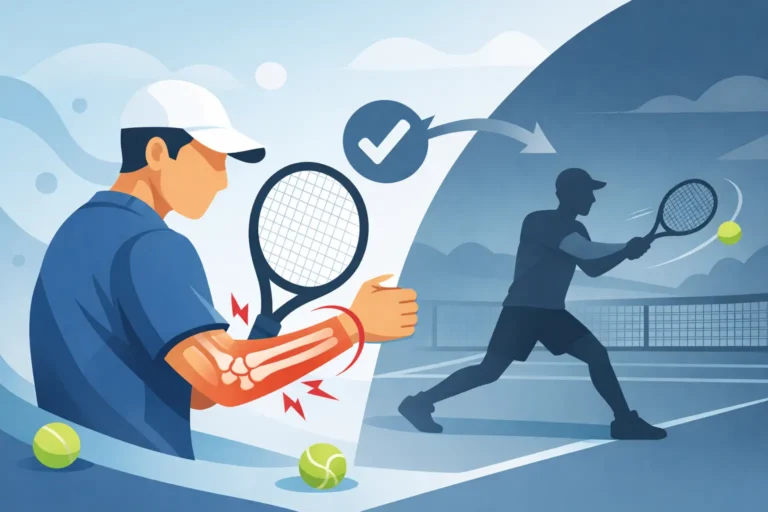
Most players are not trying to swing badly. They are reacting to a technical problem earlier in the motion. The common pattern is simple: poor preparation leads to rushed spacing, rushed spacing leads to late contact, and late contact leads to arm domination. By the time the racket meets the ball, the body has already lost control of the shot.
This is why telling a player to just relax rarely works. Relaxing does not fix a contact point that is too close to the body. It does not fix a backswing that started late. It does not fix a racket path that approaches the ball too flat and then tries to lift at the last instant.
Players also muscle because they confuse topspin with brushing only. They think they must chop steeply up the back of the ball. That creates another problem: the swing becomes weak through contact, and the ball sits up. True topspin forehands do not avoid forward drive. They combine upward action with extension so the shot has both rotation and penetration.
How to create topspin forehand without muscling
The solution starts before the swing. If the setup is right, topspin becomes a byproduct of efficient movement instead of a fight.
Start with earlier preparation
Preparation is where control begins. The turn has to happen as the ball is coming to you, not after it bounces. When the shoulders and hips coil early, the arm does not need to invent speed on its own. The racket is set, the body is organized, and the swing has time to unfold.
Early preparation also gives you the one thing muscled hitters never have – options. You can adjust your feet, judge the height of the ball, and choose a contact point in front. If you wait, all those choices disappear and the arm takes over.
For many players, this is the first major breakthrough. They think the forehand problem is about racket head speed, but the real issue is that they are always late to the first move.
Fix your spacing or the arm will take over
The cleanest forehands happen when the ball is neither jammed into the body nor reaching too far outside the strike zone. Good spacing allows the racket to accelerate freely. Bad spacing forces the hand to manipulate the path.
If you are too close, you will pull the elbow in and flip the racket. If you are too far, you will stretch and lose the ability to brush and drive through contact. In both cases, the stroke feels hard because the body is out of position.
This is why footwork is not separate from topspin. It is the foundation of topspin. Small adjustment steps are often the difference between a heavy, controlled forehand and a desperate swipe.
Make contact farther in front than you think
A muscled forehand usually meets the ball beside the body or even slightly behind it. From there, the player has no choice but to force the wrist, forearm, or shoulder to save the shot. That is where tension lives.
Topspin is much easier when contact is in front. The strings can travel up and through naturally. The body can rotate through the ball instead of dragging the arm after it. The shot feels heavier, but the effort feels lower.
This is one of the fastest corrections because the result is immediate. Move the contact point forward and the player instantly feels more space, more lift, and more control.
The racket path that produces easy topspin
The goal is not to swing straight up. The goal is to let the racket drop below the ball, approach on a low-to-high path, and continue through with speed. That path creates rotation without sacrificing depth.
Low to high, but not only up
Players often hear low to high and exaggerate the vertical part. The racket rises sharply, the ball loops too much, and pace disappears. Then they swing harder to compensate. That puts them right back into muscling.
A better image is this: the racket travels from below the ball, brushes up, and still moves out toward the target before the wrap finishes. That is how advanced players create a forehand that clears the net safely and still pushes the opponent back.
The upward part creates spin. The forward part creates ball weight. You need both.
Let rotation help, but do not over-rotate
The body should contribute to the shot, but there is a trade-off. Too little rotation and the arm works alone. Too much rotation and the contact flies open early, especially under pressure.
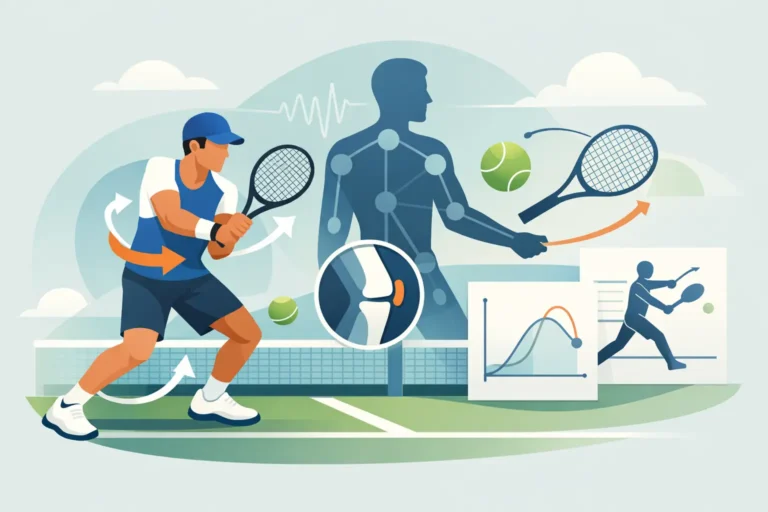
The right amount is controlled rotation from the ground up. Load, plant, unwind, and allow the racket to release. When that sequence is clean, the hand stays responsive instead of tense. The forehand becomes repeatable because the body is doing its share.
This is one reason scientifically structured instruction matters. Random tips often fix one piece while damaging another. A player might be told to use more legs, more wrist, or more shoulder turn, but without sequence those corrections do not hold.
What the hand and wrist should actually do
Many players ask if the wrist should snap. The answer is no. Forced wrist action is one of the main reasons forehands break down under speed.
The wrist should be organized, not rigid. It lays back naturally in preparation and releases as the racket accelerates. That release is a result, not a command. If you try to add extra flick, you create timing problems and lose control of the strings.
The same principle applies to grip pressure. If you squeeze too hard, racket head speed drops and feel disappears. If the grip is too loose, the racket face becomes unstable. The right feel is secure but mobile. Firm enough to control the face, loose enough to let the racket move.
Why topspin feels easier on some balls than others
Not every ball should be played with the same shape. This matters because players often muscle when they try to force one forehand pattern onto every incoming ball.
A shoulder-high ball invites a different contact and finish than a lower, skidding ball. On a high ball, you may use more windshield-wiper action and less extension. On a lower ball, you may drive a bit more through the line before the finish wraps. The core mechanics stay the same, but the exact expression changes.
That is not inconsistency. That is skill. The strongest forehands are adaptable without becoming loose or improvised.
The fastest way to know if you are still muscling
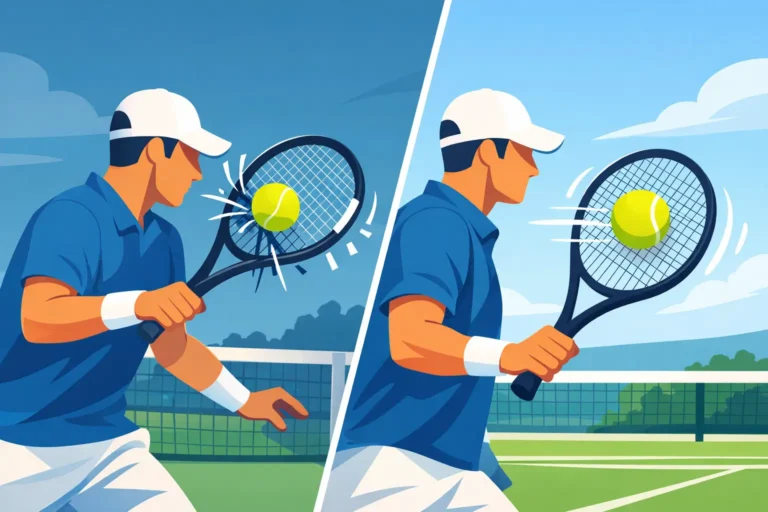
Listen to the shot and watch the recovery. A clean topspin forehand has a crisp sound, stable balance, and a finish that does not pull the player off line. A muscled forehand often sounds slappy, looks rushed, and leaves the player late for the next ball.
Another clue is fatigue. If your forehand feels heavy in the shoulder or forearm after a short rally, the stroke is probably being powered by the wrong parts. Efficient topspin does not feel weak, but it does feel smooth.
This is exactly where a precise method changes results fast. At Mili’s Split Method, players and coaches do not spend months guessing which detail is wrong. The stroke is broken down, the fault is identified, and the correction is made in a clear sequence that produces immediate change.
A better target for your practice
Do not chase more spin for its own sake. Chase a ball that clears the net with margin, lands deep, and feels effortless off the strings. That target forces you to build the stroke the right way.
If the ball arcs well but lands short, you need more extension through contact. If it travels hard but too flat, you need a better low-to-high path. If the stroke feels violent, preparation and spacing are likely late. Every miss tells the truth when you know what to read.
The best forehand is not the one that feels strongest. It is the one that keeps producing under pressure, on repeat, without strain. When the mechanics are right, topspin stops being something you try to manufacture. It becomes the natural result of a forehand built correctly from the start.
That is the standard to aim for: a ball that jumps off your strings with purpose while your body stays calm enough to handle the next one even better.