
How to Hit Deeper Tennis Groundstrokes
Most players do not miss depth because they are weak. They miss depth because their ball contact is late, cramped, or off-balance. If you want to learn how to hit deeper tennis groundstrokes, stop thinking first about power and start fixing the exact mechanics that control ball penetration.
A deep groundstroke is not just a harder shot. It is a cleaner shot. The ball travels deep when the racket meets it at the right distance from the body, with a stable base, a committed swing path, and enough body drive to send energy through the court instead of up into the air or down into the net. That is why two players can swing equally hard and get completely different results.
At Mili’s Split Method, this is treated as a technical problem with a precise solution. Players who have spent months trying to hit deeper often change it fast once the real cause is identified. Depth is not random. It is trainable, measurable, and repeatable.
Why your groundstrokes land short
Short balls usually come from one of five errors. The first is late contact. When contact happens too far back, the racket face often opens or breaks down, and the ball floats short. The second is poor spacing. If the ball crowds your body, you lose extension and drive.
The third is falling backward at impact. A player who leans away from the ball cannot send force through it. The fourth is an incomplete swing path, where the player decelerates or cuts across too sharply. The fifth is a false idea that topspin automatically means safety. Heavy topspin is useful, but if the ball is struck with no forward intention, it lands short and sits up.
This is where many players waste time. They try to solve a contact problem with strength training, a string change, or a cue like “swing harder.” That rarely works for long. Depth comes from better ball striking, not from trying harder.
How to hit deeper tennis groundstrokes with cleaner contact
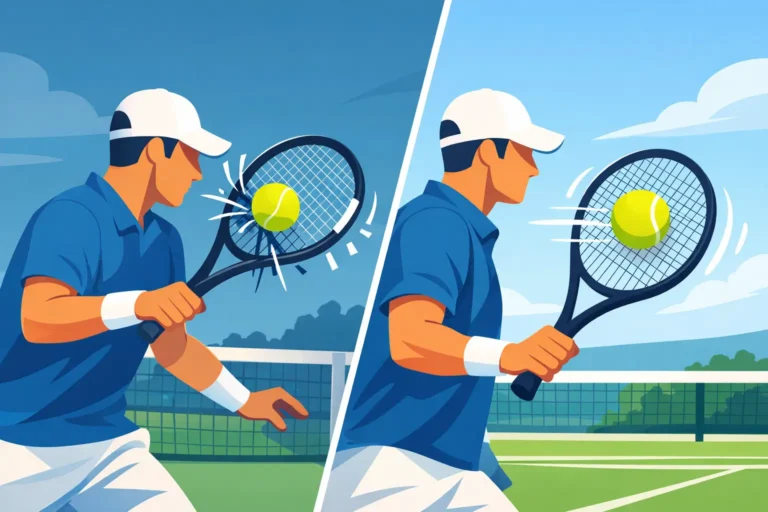
If you want immediate change, start with contact point. On both the forehand and backhand, the ball has to be struck slightly in front of your body. Not too far in front, where you overreach and lose control, but clearly not beside your hip or behind it.
When contact moves forward, three things improve at once. You get a more stable racket face, better extension through the shot, and a ball that leaves the strings with more penetration. This is the fastest route to deeper shots for most players.
A simple test tells you a lot. Rally at medium speed and notice where your deepest balls come from. They almost always come from the contact that felt clean and comfortably in front. Your short balls usually came when you jammed yourself or waited too long.
Depth is built on timing. Timing is built on preparation. If your unit turn starts late, your contact will be late. That is why the fix often begins before the swing even starts.
The spacing mistake that kills depth
Players love to talk about racket speed, but spacing decides whether racket speed can be used at all. If you stand too close to the bounce, your arm collapses. If you stand too far, you reach and lose structure. In both cases, the shot loses depth.
Good spacing gives the swing room to travel through the ball. You can extend, rotate, and finish without compensating. Bad spacing forces emergency contact.
This is especially obvious on wide balls. Many players move to the ball, then stop moving their feet too early. The upper body takes over, the swing gets crowded, and the ball lands in the service box. The fix is not more effort with the arm. The fix is one more adjustment step so the contact point returns to a strong position.
Balance decides whether the ball penetrates
You do not need to look perfect to hit deep, but you do need a stable base at contact. If your head lifts, your shoulders spin out early, or your weight drifts backward, depth disappears.
The best baseline hitters send body weight into the ball even when they are using open stances. That does not always mean stepping straight forward. It means the body is organized so energy goes through the shot. The chest stays controlled, the base is grounded, and the finish is driven rather than rescued.
If you often hit short under pressure, check your balance first. Pressure exposes unstable mechanics. A player with a clean structure can still drive the ball deep when rushed. A player with poor balance loses depth immediately.
The swing path that creates depth without losing margin
Some players hear “hit deeper” and start hitting flatter. That can work for ten minutes, then errors pile up. Others brush too much and produce spin with no push. Neither approach is complete.
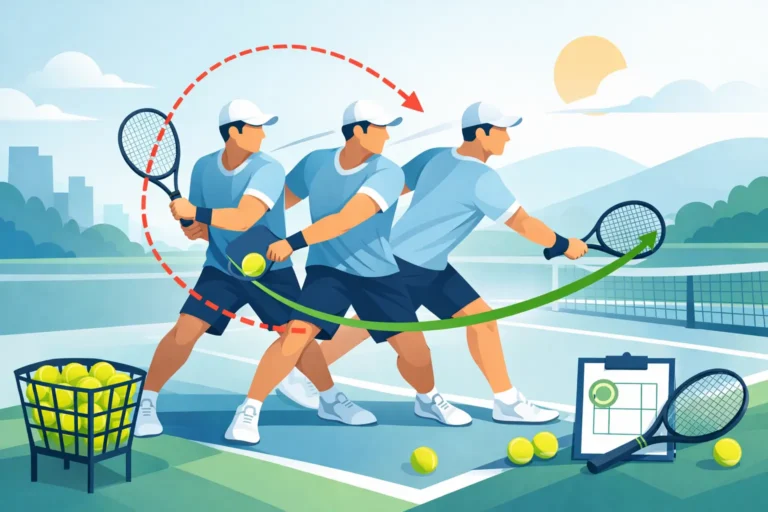
The correct path is low to high with clear forward extension. That combination matters. Low to high gives shape and net clearance. Forward extension gives depth. If one side is missing, the shot breaks down.
On the forehand, this means the racket should accelerate up and through the ball, not only around the body. On the backhand, especially the two-hander, players need both hands working through contact instead of pulling off early. The feeling is not to lift the ball. The feeling is to drive it with shape.
This is where serious players separate from recreational guesswork. They stop choosing between spin and depth. They learn how to produce both.
How to hit deeper tennis groundstrokes in matches
Practice depth is one thing. Match depth is another. In matches, players rush, shorten the backswing, and steer the ball. They become careful instead of clean.
To keep depth under pressure, use a simpler intention. Do not aim for the baseline on every ball. Aim to send the ball deep through the middle third of the court and above net height with conviction. That target gives you margin and still pushes your opponent back.
You also need to recognize when depth depends on height. If you are stretched wide or defending, trying to blast a flat deep ball is low percentage. A higher, heavier ball that lands near the baseline is the correct shot. If you are balanced and inside the court, then a more direct penetrating ball makes sense. Good depth is not one shape. It depends on the situation.
That is what many players miss. They want one instruction for every ball. Tennis does not work that way. The principle stays the same, but the expression changes based on time, balance, and incoming pace.
Drills that actually improve depth
The best drill is not complicated. Rally crosscourt and set a depth zone about three feet inside the baseline. Your goal is not to hit winners. Your goal is to make that zone your normal landing area. If the ball keeps landing short, do not swing harder. Check contact point and spacing first.
A second strong drill is live-ball recovery with movement. Feed one neutral ball, one wide ball, then one neutral ball again. This exposes whether your depth disappears when footwork is tested. For many players, that is the real issue.
A third drill is height control. Alternate one heavier ball with more net clearance and one more driving ball, both landing deep. This teaches you to create depth in more than one way, which matters in real points.
If you are coaching, or if you train seriously on your own, film ten forehands and ten backhands from the side. You are looking for three things: contact in front, body balance at impact, and a swing that goes through the ball before wrapping. Those checkpoints reveal the truth fast.
What players get wrong about power and depth
Power helps, but it is not the foundation. Plenty of strong athletes still hit short because their technique leaks energy. Plenty of younger or lighter players hit deep because they strike cleanly.
This matters because chasing power too early usually makes the problem worse. The swing gets bigger, timing gets later, and balance gets looser. Then the player feels forced to guide the next ball, which creates even less depth.
The better path is direct. Fix the contact. Fix the spacing. Fix the body organization. Then add speed. That sequence produces reliable depth instead of occasional depth.
And yes, equipment can influence feel. Tension, string type, and racket setup all matter a little. But they are not the main answer for short groundstrokes. Technique is. Players improve fastest when they stop searching for gear solutions to mechanical faults.
If your groundstrokes keep landing short, the answer is not hidden. A deep ball comes from a body that is set correctly, a contact point that is in front, and a swing that drives with shape. Once those pieces are corrected, the court starts looking smaller, your opponent starts backing up, and rallies start turning in your favor. That is when depth stops being something you hope for and becomes something you expect.