Tennis Swing Path Correction Plan That Works
Most players do not have a power problem. They have a path problem. If your racket travels on the wrong line for even a fraction of a second, the ball tells on you immediately – late contact, weak pace, floating depth, or a shot that sprays wide for no obvious reason. A real tennis swing path correction plan does not guess. It identifies the exact part of the path that breaks down and fixes it with repeatable, measurable reps.
That distinction matters because players often chase the wrong solution. They change grip when the issue is timing. They try to swing harder when the issue is the angle of approach into contact. They add more topspin when the racket is actually cutting across the ball too early. The result is weeks of effort with no dependable change. Serious players and coaches need a plan that removes confusion and creates clean ball behavior fast.
What a tennis swing path correction plan actually fixes
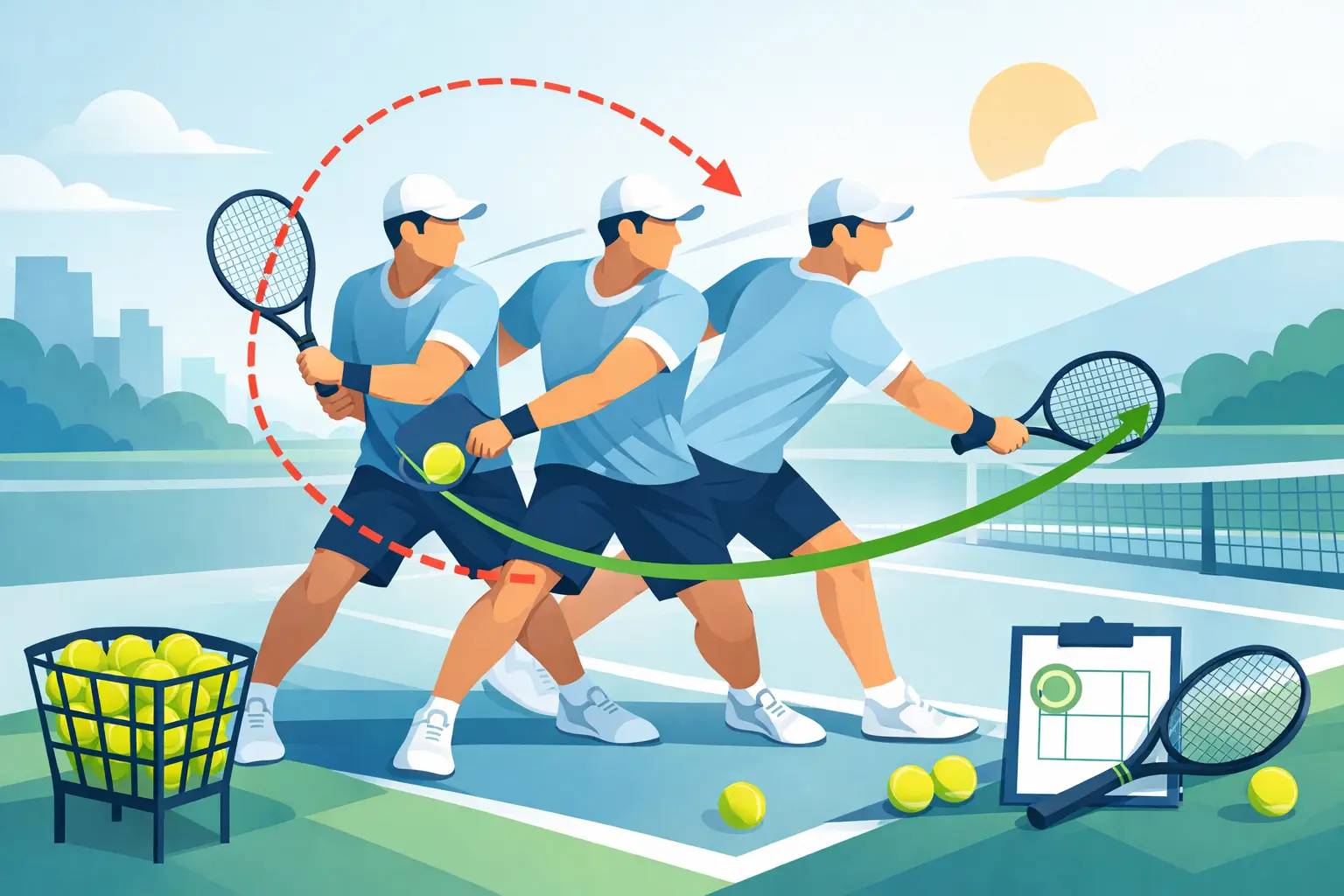
Swing path is not just the shape of the follow-through. It is the full route of the racket from preparation to extension. On the forehand, it determines whether the racket arrives under control, enters contact on time, and drives through the proper lane before wrapping. On the backhand, it decides whether the shot stays connected and solid or breaks apart into arm-only compensation.
When the path is wrong, the symptoms are usually obvious even if the cause is not. A forehand that lands short and spins too much often comes from a path that rises too sharply too early. A backhand that feels rushed and cramped often comes from a path that starts behind the body and never gets into a clean forward lane. A ball that consistently pulls left or right may come from a path that cuts across contact instead of extending through it.
This is why broad advice fails. “Brush up more” is too vague. “Turn earlier” might help one player and hurt another. Correction starts when you isolate where the path breaks – setup, drop, approach to contact, contact, or extension.
The 4-part correction sequence
A reliable tennis swing path correction plan is built in sequence. If you skip steps, the old swing returns under pressure.
1. Clean the setup before you touch the swing
Players love to talk about contact, but contact is usually lost much earlier. If the unit turn is late, if the spacing is too tight, or if the non-dominant side is inactive, the racket path has no chance to organize itself. You cannot force a clean path out of a rushed setup.
Start with the first move after recognition. On both wings, the turn must happen early enough that the racket can travel on one clear track instead of making last-second detours. The chest should organize the shot, not the hand alone. If the body sets the line, the racket can follow it. If the hand improvises, the path gets noisy.
2. Control the approach into contact
This is the section most players misunderstand. They think the swing path is either low to high or flat. In reality, it is both directional and timed. The racket can rise, but it still has to travel into the ball on a stable forward lane. Too much vertical action too soon creates spin without penetration. Too much across-the-body action too soon creates pull and inconsistency.
The fix is simple in concept and demanding in execution. The racket must approach contact from a repeatable slot, with the hand and racket head organized so the face can stay stable through impact. That slot differs slightly by height, stance, and incoming speed. This is where one-size-fits-all coaching starts to fail. The correct path depends on the ball you are receiving and the shot you are trying to send.
3. Extend before you release
Many players finish the swing before they have completed the strike. They wrap the racket because they have been taught the look of the finish rather than the function of the path. Extension is not decorative. It is where direction, penetration, and balance are confirmed.
If your shot feels flashy in practice but unreliable in matches, this is often the missing piece. The racket needs a clear travel lane through the ball before the natural release happens. On the forehand, that means the swing continues along the intended target line long enough to stabilize the ball. On the two-handed backhand, it means both hands support a unified path instead of the dominant side taking over too soon.
4. Add speed only after the path holds
Speed magnifies truth. If the path is wrong, faster swings produce louder misses. Once the track is clean, racket head speed becomes an advantage instead of a liability. This is why elite correction does not start with intensity. It starts with exactness.
The fastest improvements come when players earn speed in layers. First slow and exact. Then moderate and consistent. Then match-speed under changing feeds. This progression is not cautious. It is efficient. It saves players from grooving the wrong motion at full pace.
Why players stay stuck with swing path issues
The biggest reason is compensation. Talented athletes can hide a bad path with timing, hand skill, or foot speed for a long time. They still compete. They still hit good shots. But under pressure, fatigue, or pace, the compensation breaks and the stroke collapses.
The second reason is that most correction is too verbal. Players hear ten cues and keep none of them under live-ball conditions. Real change comes from a teaching method that makes the right path feel obvious and repeatable. That is why direct, structured coaching works better than generic instruction. The player has to experience the correct route, not just hear about it.
The third reason is poor diagnosis. Coaches often treat the result instead of the cause. If the ball flies long, they talk about racket face. But the face may only be unstable because the path arrived late. If the player frames the ball, they talk about footwork. But the feet may be fine while the hand path is looping unnecessarily. Precision matters.
What fast correction looks like on court
A good correction plan produces visible changes quickly. The ball starts leaving the strings with a more predictable shape. Mishits drop. The player feels less rushed. Direction improves without extra effort. Perhaps most important, the stroke begins to hold up when the tempo rises.
This is where confidence becomes earned rather than hoped for. Players trust the shot because the mechanics stop changing from ball to ball. Coaches trust the process because they can point to checkpoints that are clear and repeatable.
At Mili’s Split Method, that is the standard. The objective is not endless adjustment. It is rapid correction with a method specific enough to identify the fault and direct enough to remove it. When the teaching is precise, players do not need months to understand their swing path. They need the right sequence and enough accurate reps to make it automatic.
How to practice a tennis swing path correction plan without wasting reps
Start with fed balls before live rallying. That is not a step backward. It is how you remove noise and verify the path. The player should know exactly what ball is coming, what target is intended, and what part of the path is being trained. Random rallying too early hides whether the correction is real.
Next, use contrast. Hit a few balls with the old path intentionally, then switch to the corrected one. This sharpens awareness fast. Players often improve sooner when they can feel the difference clearly rather than chasing a vague better swing.
Then test under pressure. Increase pace, vary height, and add movement. If the path holds only on comfortable feeds, it is not corrected yet. A plan is complete when the swing survives the conditions that used to expose it.
Finally, keep the focus narrow. One session should center on one fault in one section of the path. Trying to fix setup, spacing, wrist position, and finish all at once usually slows improvement. Efficient coaching is selective. It changes the one thing that changes everything else.
The trade-off players need to accept
When you correct a swing path, there is often a short adjustment window. Timing may feel different for a day or two because the racket is no longer taking the familiar detour. That is normal. The old pattern may feel easier at first simply because it is older, not because it is better.
This is the point where committed players separate themselves. They do not judge the correction by one awkward session. They judge it by ball quality, repeatability, and match transfer. If those improve, the plan is working.
A dependable stroke is not built from guesses or motivational tips. It is built from exact diagnosis, exact correction, and exact repetition. If your forehand or backhand keeps breaking down the same way, stop treating it like a mystery. The right path can be taught, felt, and repeated – and once it is, the game gets simpler very quickly.