
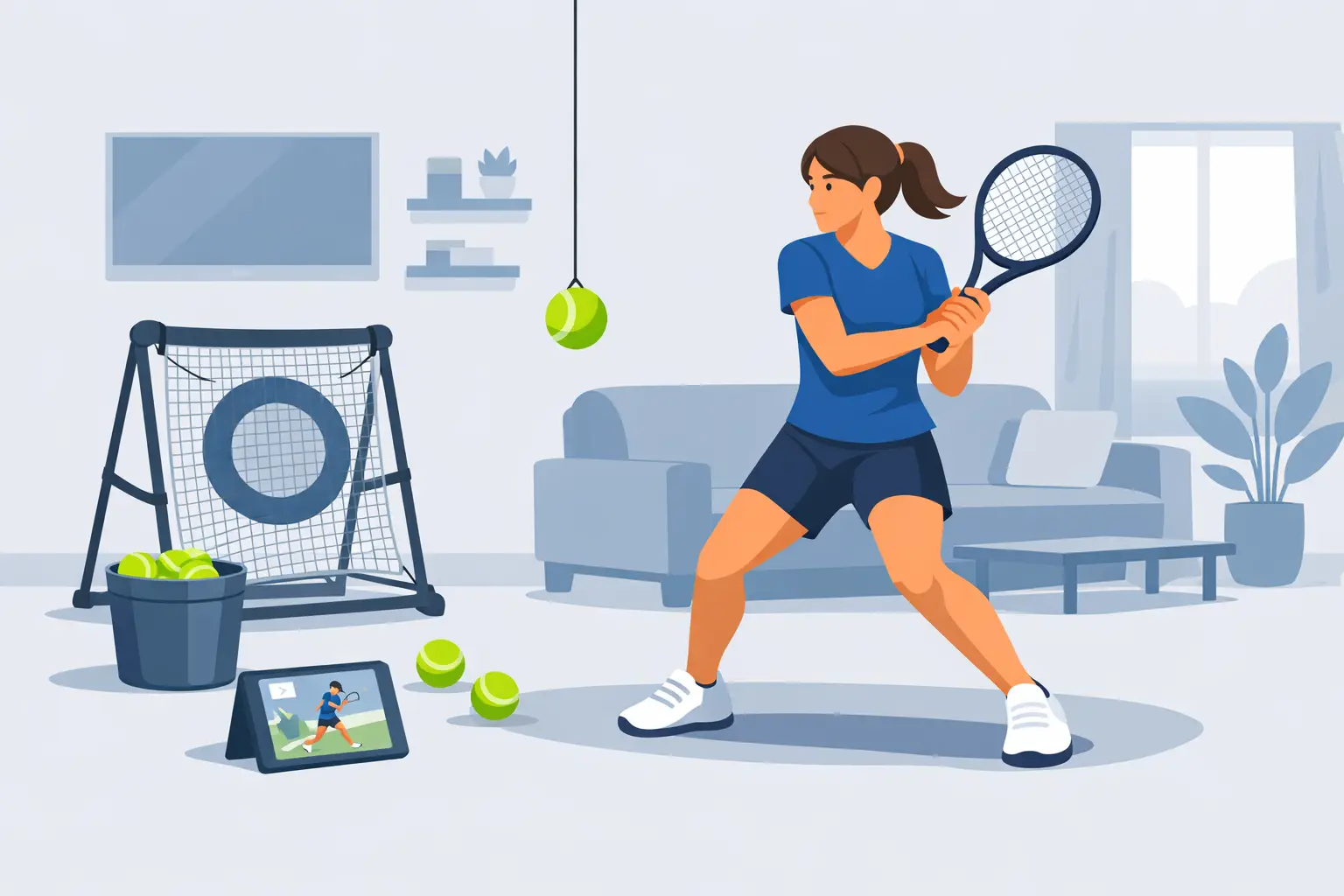
If your two-hander feels clean in slow practice but breaks down the second the ball speeds up, you do not have a power problem. You have a timing problem. A good two handed backhand timing drill at home fixes that by training the one thing most players miss – when the body loads, when the hands set, and when contact actually happens.
Most home drills fail because they focus on motion without pressure. The player shadows a nice-looking swing, but the brain never learns the real sequence. Timing is not just racket speed. It is the relationship between split step, unit turn, spacing, and contact point. Get that sequence right and the stroke becomes repeatable. Get it wrong and even talented players start guiding the ball, arming the swing, or making late contact.
Why the two handed backhand breaks down on timing
The two-handed backhand is extremely reliable when the sequence is correct. That is exactly why timing errors stand out so clearly. When a player is late, the shoulders usually turn too slowly, the outside leg does not stabilize the body, and the hands get dragged into contact. The stroke looks rushed because it is rushed.
At home, you can isolate this better than you can on court. On court, players often blame the ball. At home, there is no excuse. If the setup is off without a live rally, the issue is technical. That is good news, because technical issues can be corrected fast when the drill is precise.
The biggest mistake is practicing the finish instead of the contact. Contact is where timing lives. If your contact point is too close to the body, too far in front, or inconsistent from rep to rep, your backhand will never hold up under pace. That is why the right drill has to train the approach into contact, not just the follow-through.
The best two handed backhand timing drill at home
You do not need a court. You need a racket, enough space to swing safely, and a ball you can self-feed. A foam ball is ideal indoors, but a regular tennis ball works if you have room and control. The goal is simple: build a repeatable rhythm from ready position to contact.
Start in your normal ready position. Perform a small split step, then turn the shoulders immediately as if you are reading a backhand. Your hands move with the turn, not after it. From there, drop or softly toss the ball into your strike zone and make the swing only when the ball reaches your ideal contact height. That detail matters. Do not rush to meet the ball. Let the ball enter your window, then fire.
This is the rhythm:
Split, turn, set, contact.
Not split, wait, panic, swing.
The first phase teaches recognition. The second teaches organization. The third teaches exact timing. Players who improve quickly stop treating the backhand as one long motion. They train it as a sequence with clear checkpoints.
How to perform the drill correctly
Stand sideways enough to feel your coil, but not so closed that you jam the swing. Your back foot should help you load, and your front side should give you direction. Keep the hands connected to the body turn early. If the racket goes back independently, your timing will drift.
Now self-feed the ball. The feed should be low-stress and repeatable. Drop it slightly in front of your lead hip, allow one controlled bounce if space requires it, and strike it at your usual contact point. If you are advanced and have room, you can use a no-bounce toss. If you are rebuilding mechanics, one bounce is often better because it slows the drill down enough to expose flaws.
The key is not hitting hard. The key is arriving on time with shape and balance. You should feel the lower body organize first, then the torso unwind, then the hands deliver the racket through contact. If your hands dominate too early, you will feel quick but unstable. That is false timing.
What this drill is actually training
A proper two handed backhand timing drill at home trains three things at once. First, it teaches your eyes to match ball height with swing initiation. Second, it teaches your body to set spacing before the swing starts. Third, it grooves a contact point that does not wander.
This is why the drill works so well for both players and coaches. It removes noise. You can see immediately whether the player is late with the turn, cramped at contact, or overreaching. Those are not separate problems. They are timing errors showing up in different forms.
The checkpoints that matter most
The first checkpoint is the split step. It must happen before the turn, not during the swing. Many players at home skip this because there is no incoming shot. That is a mistake. Timing starts before the racket moves.
The second checkpoint is the unit turn. The shoulders and hands move together. If the shoulders stay square too long, the swing becomes handy. If the turn is early and complete, the stroke has time.
The third checkpoint is spacing. Your contact should sit far enough from the body that the arms can extend through the ball, but not so far that you lose structure. A player who constantly crowds the backhand will always feel rushed, even on slow balls.
The fourth checkpoint is head stability through contact. If the head pulls off early, timing gets distorted instantly. Players often think they are late because the ball is fast. In many cases, they are late because they lift and rotate out too soon.
Common mistakes during home backhand timing work
The most common error is over-swinging. Players try to create confidence by hitting harder, but speed hides flaws. Slow, clean reps build timing faster than aggressive, messy ones.
The next problem is inconsistent feeding. If every toss is different, every rep teaches a different pattern. You are not training timing then. You are training survival. Make the feed simple enough that the same movement can be repeated again and again.
Another major issue is practicing too far from realistic contact. Shadow swings have value, but only when they match actual spacing. If you rehearse contact six inches farther in front than where you really strike the ball, you are wiring in the wrong solution.
Finally, many players do not use the legs. They stand tall, swing with the arms, and wonder why the backhand disappears under pressure. The two-hander is not just a hand action. The base controls the clock.
How players and coaches should progress the drill
Beginners and rebuilding players should start with a stationary self-feed and a pause after the unit turn. That pause makes the sequence obvious. It is not how you will hit in a match, but it is exactly how you expose the mistake.
Intermediate players should remove the pause and blend split step into the turn. Once that feels natural, vary the feed slightly in height while keeping the same contact discipline. This teaches adjustment without losing structure.
Advanced players and coaches should add movement. Start from a neutral ready position, take one adjustment step, then perform the same drill. If the backhand holds up while moving, the timing is becoming match-ready. If it falls apart, the player still does not own the sequence.
This is where serious coaching stands apart from generic advice. Fast improvement does not come from doing more reps. It comes from doing the exact reps that remove the fault. That is the standard behind Mili’s Split Method. The correction is direct, measurable, and fast because the drill is built around the real cause, not the symptom.
How often to do this two handed backhand timing drill at home
Daily work beats marathon sessions. Ten focused minutes is enough if the drill is honest. Twenty minutes is plenty if your attention stays sharp. Once the reps get lazy, the value drops.
For players in active competition, this drill is best used as technical maintenance. For players rebuilding the stroke, it should be a short daily habit for at least several days in a row. Consistency matters more than volume because timing is a nervous system skill. You are not just strengthening a movement. You are calibrating it.
A simple standard works well. If you can produce clean contact and balanced finish on eight out of ten reps, progress the drill. If not, stay at the current level until the movement becomes automatic.
What success should feel like
When the drill is working, the stroke feels quieter. You stop chasing the ball with the hands. The turn starts earlier, the contact point appears more clearly, and the swing stops feeling rushed. That is real progress.
You should also notice something else – the backhand starts to hold under pressure even before you spend a lot of time on court. That happens because correct timing transfers. A mechanically sound sequence does not need ideal conditions to survive.
If your two-hander has been inconsistent, do not keep guessing. Train the sequence until the timing is undeniable. The body learns what it repeats, and when the repetition is precise, results come fast. A few clean minutes at home can change what happens on match day.