Tennis Groundstroke Biomechanics Simple Guide
If your forehand feels strong one day and unreliable the next, the issue usually is not effort. It is sequence. A tennis groundstroke biomechanics simple guide should start there, because most stroke problems come from the wrong body parts firing at the wrong time. Players often try to fix the hand, the wrist, or the finish. The real fix is lower in the chain and earlier in the motion.
Groundstrokes look fast, but the best ones are built on simple, repeatable mechanics. When the body loads in the right order and unloads in the right order, power becomes easier, timing improves, and control stops feeling random. That is why biomechanics matters. Not as a theory lesson, but as the fastest route to a dependable forehand and backhand.
Tennis Groundstroke Biomechanics Simple Guide: What Actually Matters
Biomechanics is just the study of how the body moves and produces force. In tennis, that means how your feet, legs, hips, trunk, shoulder, arm, and racket work together. The key word is together. A groundstroke breaks down when one segment dominates or lags behind.
Most recreational players swing from the arm first. That creates effort without efficiency. The racket speed may look high, but the ball quality is inconsistent because the larger body segments never set up the stroke. Advanced players do the opposite. They organize the body first, then let the arm deliver what the body already created.
This is why two players can appear to swing with similar speed while producing very different balls. One is forcing speed. The other is transferring speed.
The Kinetic Chain Behind a Clean Groundstroke
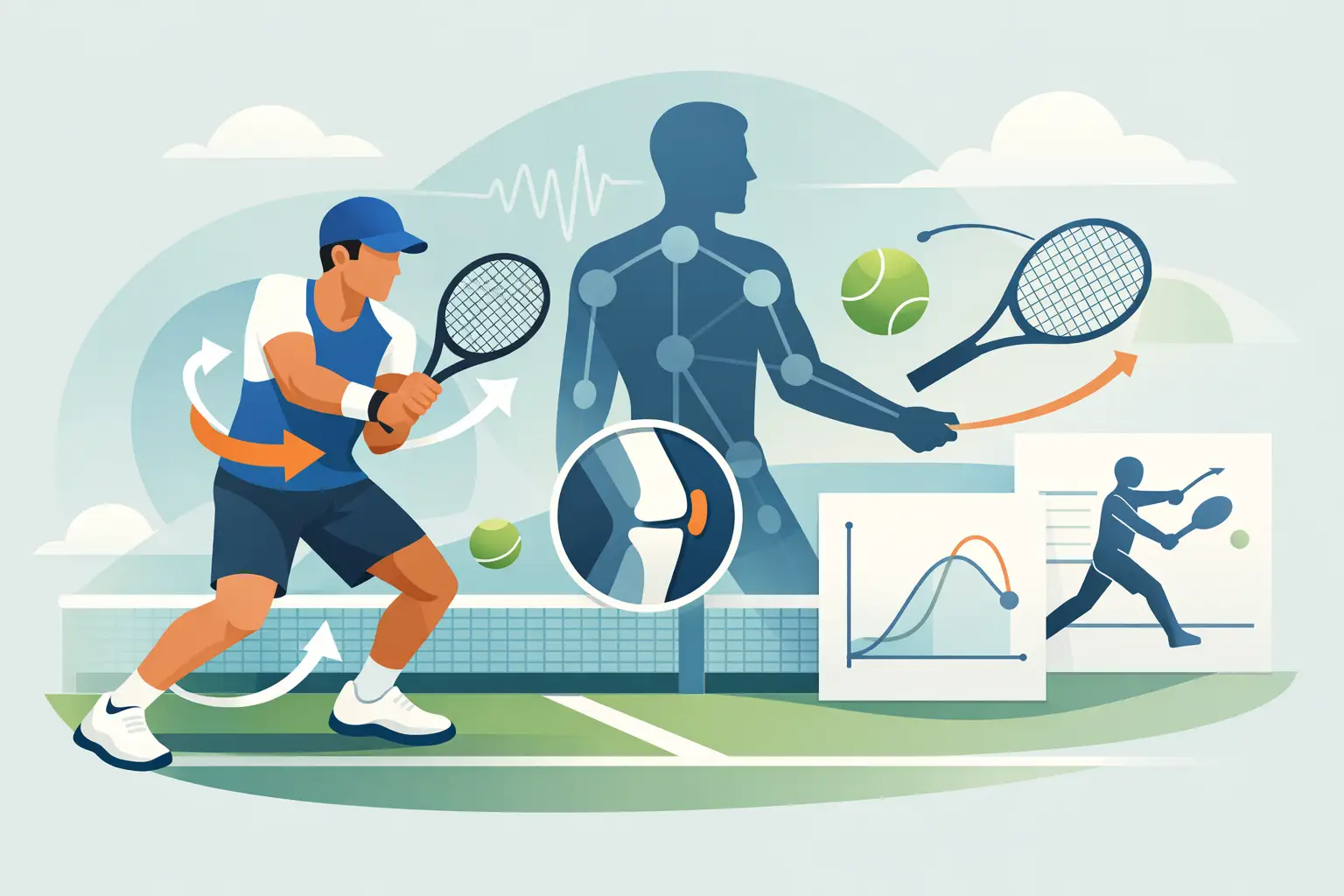
A clean groundstroke starts from the ground. Your feet create the base, your legs load force, your hips begin rotation, your trunk carries and amplifies it, and the arm and racket express it at contact. If the chain is ordered, the stroke feels smooth. If the chain is broken, the stroke feels rushed, late, or weak.
Think of it this way. The racket should not be the engine. It should be the final link. When players lead with the racket, they usually open too early, lose spacing, and make contact with a collapsing structure. That is when mishits show up, especially under pace.
The exact pattern changes based on stance, incoming ball, and tactical intention. An open-stance forehand on a heavy crosscourt exchange does not look the same as a neutral-stance forehand on a short ball. But the principle stays the same. Stable base, organized load, efficient rotation, and clean transfer into contact.
The Load: Where Power and Timing Begin
The load phase is where most stroke quality is won or lost. Before the racket accelerates, the player needs to organize the body. This means balance, spacing, and coil.
Balance does not mean standing upright and still. It means the center of mass is controlled so the body can move into the ball instead of falling away from it. Spacing means the body is the right distance from the ball so the arm can extend naturally. Coil means the trunk and hips create stored energy instead of starting flat and square.
On the forehand, strong players load through the outside leg in many open-stance situations. That leg accepts force and gives the hips something to work from. On the two-handed backhand, the load often feels more connected through the legs and trunk, with the body turning as a unit before release. On the one-handed backhand, timing and posture become even more demanding because the contact structure is less forgiving.
If you are late, off balance, or jammed, the problem often happened before the swing began. That is why serious correction starts with the setup, not the follow-through.
The Contact Point Is the Truth
Players love to talk about takeback and finish, but contact tells the truth. If the contact point is unstable, the stroke is unstable.
Good contact is not only about where the ball meets the strings. It is also about body shape at that instant. The head is quiet. The trunk is organized. The hitting structure is stable. The racket face is controlled. The player is not reaching as a last-second rescue.
On the forehand, contact generally happens slightly in front of the body, with enough extension to drive through the ball without locking the arm. On the two-handed backhand, contact is also out in front, but the feeling is different because both hands help stabilize and guide the racket path. On either side, being too close or too far destroys leverage.
This is one reason players can look fine in shadow swings and still break down in live rallies. Without proper spacing and timing into contact, textbook positions disappear.
Rotation, Not Spinning
Rotation creates power, but uncontrolled rotation destroys accuracy. Many players hear “use your hips” and start spinning open too early. That is not efficient biomechanics. It is energy leaking out before contact.
Effective rotation is connected rotation. The lower body initiates, the trunk follows, and the upper limb releases into a stable path. The chest does not need to fly open at the start. It needs to support the racket arriving to contact with speed and shape.
This is where coaching matters. Players often cannot feel the difference between productive rotation and wasted motion. They think more turn equals more power. In reality, better sequencing is what raises ball quality. Less noise, more transfer.
The Racket Path and Ball Shape
Biomechanics is not only about power. It also determines the ball you produce. Flat, heavy, topspin, neutral rally ball, aggressive drive – each one comes from a different blend of racket path, contact orientation, and body organization.
For topspin, the racket typically approaches from below the ball and accelerates up and through, but that does not mean the player should just brush wildly upward. Pure upward brushing without forward transfer creates a weak ball. The strongest topspin forehands combine lift with penetration.
For flatter drives, the path is more direct, but the body still has to support the strike. If players chase flat hitting without stable mechanics, they usually lose margin and spray errors. Good biomechanics gives you options. Poor biomechanics traps you in compensation.
Why Simple Corrections Work Faster
A lot of traditional instruction overwhelms players with too many details at once. Elbow here, wrist there, shoulder there, finish higher, step more, relax more. That is not efficient. The body learns movement through clear priorities.
The fastest improvement usually comes from fixing one or two chain errors that cause multiple visible faults. Change the load and you often change timing, spacing, and contact. Change the contact structure and you often change control, power, and recovery. This is why a precise system gets results faster than random tips.
That is also why a method like Mili’s Split Method stands out. When stroke correction is built around biomechanics and sequencing instead of guesswork, players do not need months of confusion. They need the right correction applied the right way.
What Players and Coaches Should Look For
If you are evaluating a forehand or backhand, do not start with style. Start with function. Ask a direct question: where is the chain breaking?
Is the player loading too late? Are they crowding the ball? Are they opening the trunk early? Is the contact collapsing? Is the arm trying to create speed that should come from the ground and trunk? These are useful questions because they reveal causes, not just symptoms.
For coaches, this matters even more. If you misread the source of the error, you prescribe the wrong fix. A player with poor spacing may look like they need hand adjustments. A player with early trunk rotation may look like they need a different finish. But if the diagnosis is wrong, the lesson becomes expensive repetition.
For players, the lesson is simple. Stop chasing cosmetic changes. Chase a body sequence that repeats under pressure.
It Depends: Forehand and Backhand Are Not Identical Problems
A simple guide still needs honesty. There is no single groundstroke model that fits every player in every situation. Height, mobility, grip style, stance preference, and tactical intent all influence the stroke.
A modern open-stance forehand on clay has different demands than a flatter attacking forehand on a hard court. A two-handed backhand gives more stability on return and high balls, while a one-handed backhand offers different reach and slice transition options but asks for cleaner timing. So yes, it depends.
But the non-negotiables remain. Efficient loading. Stable spacing. Organized rotation. Contact in a strong structure. Racket speed produced by sequence, not panic.
That is what makes biomechanics practical. It cuts through style debates and gets to what holds up in real tennis.
If your groundstrokes are inconsistent, do not assume you need more effort or more repetition. Usually, you need better mechanics applied in the right order. When the sequence is right, the ball tells you immediately. It leaves the strings cleaner, heavier, and with far less strain. That is the kind of change players feel fast and coaches can trust on court.