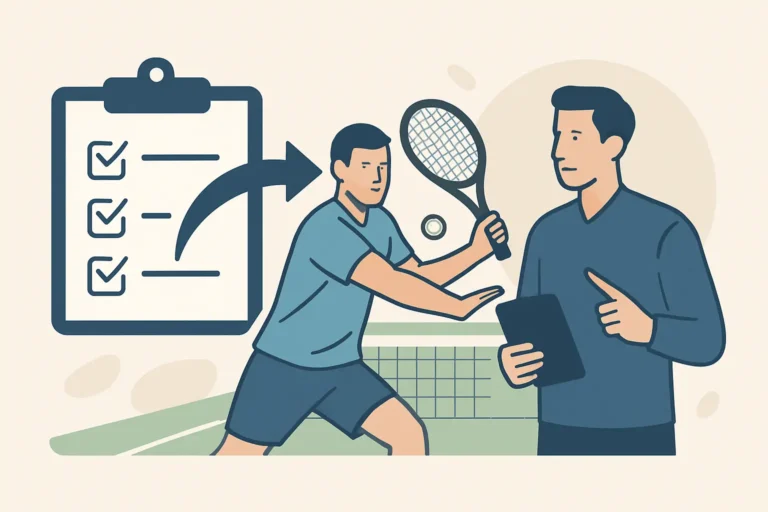

How to Reduce Tennis Unforced Errors Fast
You do not lose most matches on spectacular winners. You lose them on the ball you should make. A routine forehand dumped in the net, a backhand sailed long, a rushed rally ball from a bad contact point – that is usually where the score shifts. If you want to reduce tennis unforced errors fast, stop treating mistakes like a mindset problem first. In most cases, they are a stroke problem, a spacing problem, or a decision problem.
Players often hear vague advice like “move your feet” or “stay relaxed.” That sounds helpful, but it does not fix the ball that keeps landing three feet long under pressure. Fast improvement comes from identifying which error pattern is actually costing you games and correcting it at the source. That is why some players plateau for years while others clean up their game in days.
Why unforced errors pile up so quickly
Unforced errors are rarely random. They come in clusters because one technical flaw tends to repeat under pressure. If your contact point is late on the forehand, you will not miss just once. You will miss again when the ball comes heavier, when you are stretched wider, or when nerves make your timing even later.
The same applies to the backhand. If the racket face is unstable through contact, your misses will look different on the surface – one in the net, one wide, one long – but the root cause is the same. This is where many players waste time. They try to solve five different misses instead of correcting the one movement error producing all five.
Decision-making also matters, but it sits on top of technique. A player with sound mechanics can choose safer targets and instantly compete better. A player with broken mechanics can aim safer and still leak errors. That is the hard truth. Consistency starts with a ball you can trust off both sides.
Reduce tennis unforced errors fast by fixing contact
If there is one adjustment that changes error count the quickest, it is improving contact quality. Most recreational and competitive players are not missing because they lack effort. They are missing because they strike the ball too close to the body, too far in front, or too late beside the hip.
Clean contact creates margin without forcing you to slow down the swing unnaturally. When the spacing is right, the racket path can work the way it was intended. The ball clears the net with shape and lands inside the court with less steering.
The forehand problem most players do not see
On the forehand, many players crowd the ball. They move to it, but not around it. That leaves no room for the arm and racket to accelerate on the proper path. The result is a cramped contact, a wristy correction, and an error that feels mysterious even though the cause is clear on video.
The fix is not simply “watch the ball.” It is creating the correct distance every time. Good forehands come from organized feet, stable spacing, and contact that is neither jammed nor reached. Once that geometry is right, the stroke calms down fast.
The backhand error that keeps showing up in matches
On the backhand side, players often compensate with the hands because the body setup is late. That can work in practice when the feed is predictable. In a match, it collapses. The shot loses structure, especially on higher pace and wider balls.
A reliable backhand needs a repeatable setup before contact, not a rescue move during contact. This is one reason technical correction matters so much. If your stroke only works when the ball is perfect, it is not match-ready.
Footwork matters, but only the right kind
Telling a player to move faster is incomplete. The issue is usually not speed alone. It is footwork quality in the final steps before contact. Many unforced errors happen after decent movement because the last adjustment steps are missing.
Those final steps set your distance, balance, and hitting height. Without them, you swing while still drifting. That is why the same player can look athletic and still spray balls. Effort is there. Precision is not.
This is also why fast improvement is possible. You do not need months to understand whether your feet are organizing the strike or sabotaging it. The right training exposes that immediately and gives you a repeatable correction, not a motivational speech.
Stop aiming smaller when your stroke is unstable
A common reaction to errors is to play safer by hitting softer and aiming farther from the lines. Sometimes that helps for a game or two. Often it creates a new problem. The player decelerates, manipulates the racket face, and actually becomes less stable through contact.
Smart margin is good. Passive hitting is not. The answer is to build a rally ball with shape, clearance, and dependable direction. That ball should come from mechanics you can repeat, not from fear of missing.
Safer targets still require a trustworthy swing
Yes, your patterns should become more disciplined. Crosscourt is usually higher percentage than down the line. Hitting away from the net strap gives you more net clearance. But target selection works best when the stroke underneath it is clean.
If your forehand breaks down every time the ball gets into your body, no target will save you for long. If your backhand contact floats because the structure is unstable, aiming bigger is only a temporary patch. Real reduction in errors comes when technique and patterns support each other.
The fastest way to train consistency is not endless rallying
A lot of players try to fix unforced errors by simply hitting more balls. Volume has value, but repetition without correction often hardens the mistake. You do not need more random reps. You need precise reps on the exact movement causing the miss.
That is why effective coaching changes results so quickly. A scientifically structured method isolates the fault, corrects it directly, and tests it under realistic pressure. When that happens, consistency is not a mystery. It becomes measurable.
At Mili’s Split Method, this is the standard. The goal is not to give players generic tips and hope they improve over time. The goal is to identify the exact groundstroke issue and fix it in the shortest possible window. That is why players and coaches seek out a method built for certainty, not guesswork.
What to check if you want immediate improvement
If you are serious about cutting errors fast, evaluate your game in this order. First, check contact spacing. Second, check whether your final adjustment steps are setting that spacing. Third, check whether your swing path and racket face stay stable through the strike. Only after that should you move to strategy and shot selection.
This order matters. Too many players start with tactics because it feels easier than changing technique. But if the underlying stroke is unreliable, the match plan keeps collapsing. You cannot out-think a contact problem forever.
Match pressure reveals the truth
Practice can hide flaws because the tempo is familiar and the next ball is expected. Matches expose the real issue. If your misses spike on neutral rally balls, your base stroke is not stable enough. If they spike on the run, your spacing and recovery are suspect. If they spike on big points, you may have a technical flaw that gets worse when tension rises.
Pressure does not invent problems. It reveals them. That is useful, because once the flaw is visible, it can be corrected.
Coaches and players need a correction system, not more cues
For coaches, this matters even more. Your value is not in giving louder reminders. It is in seeing what the player cannot see and providing a correction that holds up quickly. Players do not need ten swing thoughts. They need a system that identifies cause and effect with precision.
That is also why online instruction can work at a high level when the teaching model is specific enough. If the coach knows exactly what to isolate and how to correct it, the player feels the change immediately. The format matters less than the method.
Fast results come from accuracy, not intensity
Players often assume they need to grind harder to become more consistent. Sometimes they do. More often, they need more accurate feedback. Hitting harder, running more, or practicing longer will not solve a flawed contact pattern. Correcting the right movement will.
If your goal is to reduce tennis unforced errors fast, think like a problem-solver, not a survivor. Find the repeatable fault. Correct the spacing, contact, or stroke structure causing it. Then build patterns that reinforce the new ball under pressure. That is how errors drop quickly and stay down.
The best part is that once your groundstrokes become trustworthy, the whole match feels different. You stop managing fear and start managing points. That is when confidence becomes real – because it is built on a stroke that finally does what you ask.