
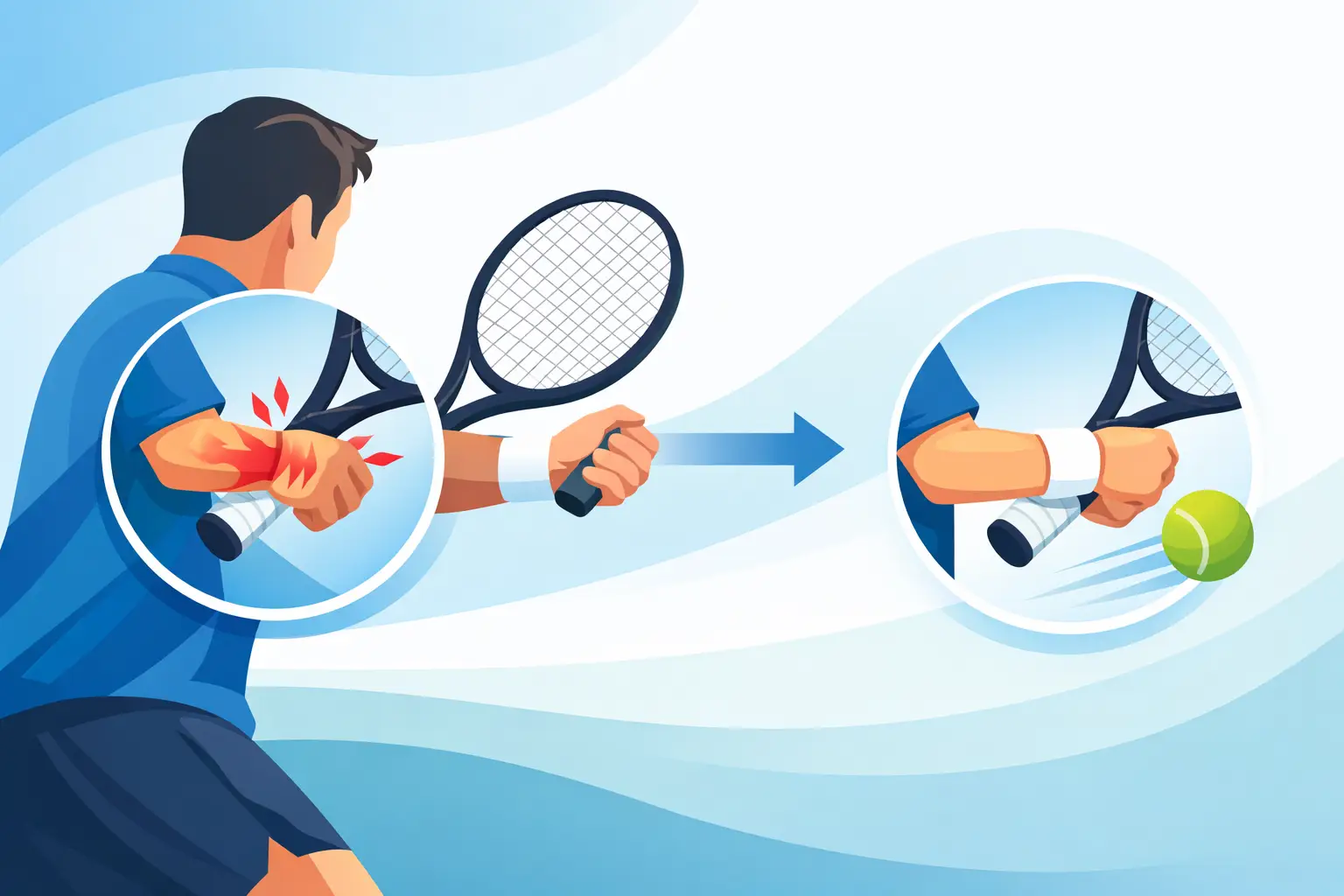
You do not need six months of guesswork to fix forehand wrist breakdown quickly. If your forehand feels soft at contact, your racket face flips open, or balls float long when you swing harder, the problem is usually not talent. It is a mechanical fault with a clear cause, and when the cause is identified correctly, the correction can happen fast.
That matters because wrist breakdown is one of the most expensive errors in tennis. It steals pace, destroys directional control, and makes your timing unreliable under pressure. Players often try to solve it by tightening the hand, changing grips every few days, or hitting hundreds of extra balls. That usually makes the forehand feel even less natural.
The faster path is technical precision. You need to know exactly what wrist breakdown is, what creates it, and what must change first.
What forehand wrist breakdown actually is
Wrist breakdown is not simply wrist movement. The wrist should not be frozen on the forehand. Good forehands have natural mobility. The problem starts when the wrist loses its structure through contact and the racket head collapses instead of staying supported by the arm and body sequence.
When that happens, the racket face becomes unstable at the most important moment of the stroke. One ball flies long. The next lands short. Then you start guiding the shot because you no longer trust your contact.
Most players describe the feeling the same way. They say the racket head feels heavy, late, or loose. Coaches often call it a weak wrist, but that description is incomplete. In most cases, the wrist is not the starting problem. It is the visible symptom.
Why players struggle to fix forehand wrist breakdown quickly
The reason many players fail to fix forehand wrist breakdown quickly is simple. They work on the wrong body part.
If you only tell a player to keep the wrist firm, the player usually adds tension. That tension slows the swing, disrupts spacing, and creates a different problem. The forehand may look more controlled for a few minutes in slow rallying, but it breaks down again as soon as the ball gets faster.
Real correction comes from the chain behind the wrist. The setup, spacing, arm structure, and contact position decide whether the wrist stays stable or collapses. Get those pieces right and the wrist behaves correctly without forced tension. Get them wrong and no verbal reminder will hold up in live points.
The three most common causes
The first cause is late contact. When the ball gets too close to the body, the player improvises with the hand. The wrist bends because the strike zone is already gone.
The second cause is poor arm structure on the forward swing. If the hitting arm disconnects or folds in the wrong sequence, the racket head takes over and the wrist gets dragged into instability.
The third cause is a flawed loading pattern. If the body does not set the stroke correctly from the split step through the unit turn, the hand ends up trying to create racket speed alone. That is where breakdown becomes chronic.
The fastest way to correct it
Fast improvement comes from removing variables. Do not start with random feeds and full-speed rallies. First restore the correct shape of the stroke in a controlled environment, then build speed, then test it under pressure.
This is where a precise teaching system matters. Mili’s Split Method is built on that principle. Instead of flooding the player with tips, it isolates the exact mechanical fault and corrects it in sequence. That is why players can make dramatic changes in days rather than dragging the issue through months of repetition.
The first priority is contact structure. At contact, the hand, wrist, and racket must align in a way that supports the ball instead of reacting to it. You are not holding the racket rigidly. You are arriving with support already in place.
The second priority is spacing. Many wrist problems disappear the moment the player stops crowding the ball. Proper spacing gives the arm room to extend and lets the body rotate through the shot. The wrist no longer has to rescue the swing.
The third priority is timing from the ground up. A clean split step, early recognition, and organized preparation give the forehand enough time to unfold. Rushed swings create hand-dominant contact. Organized swings create stable contact.
A practical correction sequence that works
Start with slow, dropped-ball forehands. This is not basic work for beginners. It is diagnostic work. If the wrist still collapses on a self-fed ball, the problem is definitely in structure, not in reaction time.
Focus on three checkpoints. First, set the racket with a clear preparation rather than a loose arm takeback. Second, create enough distance from the ball so contact happens out in front, not jammed near the hip. Third, feel the body carry the racket through contact instead of flicking with the hand.
Then move to hand-fed balls at moderate pace. The goal is not power yet. The goal is repeatable contact with the same racket orientation over and over. If the ball leaves the strings with a clean, heavy trajectory, you are on the right track. If the shot floats or sprays, stop adding speed.
Only after that should you progress to rally balls. Too many players rush this stage. They see one good basket and assume the problem is fixed. Then match pressure returns and the wrist breaks down again. Stable mechanics must survive increasing pace, wider spacing demands, and imperfect feeds.
What you should feel
The correct forehand usually feels simpler than players expect. Contact feels supported. The racket does not wobble through the ball. The hand feels present but not dominant. Power comes from timing and sequence, not from a slap.
This is a key point for advanced players and coaches. Sometimes the correction feels less aggressive at first because the old motion depended on last-second hand action. Do not confuse that old effort with quality. A stable forehand often feels calmer while producing a heavier, more reliable ball.
What not to do
Do not squeeze the grip harder to control the racket face. That reduces feel and often delays the swing.
Do not copy a professional player’s wrist position from a still photo. High-level forehands are dynamic. A frozen image does not show how the racket got there or what the player did through contact.
Do not assume the grip is always the problem. Grip matters, but many players with the correct grip still break the wrist because their spacing and sequencing are wrong. Grip changes can help, but only when they match the real cause.
Do not train the forehand exclusively at one speed. A stroke that holds together on soft balls but fails on fast balls is not corrected yet.
For coaches: why this fault must be taught differently
Coaches who want to fix forehand wrist breakdown quickly need a method, not a collection of cues. The traditional approach often overloads the player with instructions that are disconnected from the root issue. One lesson focuses on the wrist. The next focuses on the follow-through. The next changes the stance. The player becomes more confused and less automatic.
A stronger approach is to identify the earliest point in the stroke where the error becomes inevitable. That is where efficient coaching lives. If the setup is wrong, do not coach the finish. If spacing is wrong, do not blame the hand. If timing from the split step is late, do not ask for more acceleration.
This is why elite correction looks fast from the outside. It is not magic. It is specificity.
How quickly can it change?
If the problem is diagnosed accurately, players often feel a major difference in one session. That does not mean perfection is automatic. It means the cause has been removed and the correct pattern is now available.
For some players, especially those with years of compensations, the adjustment phase includes a temporary drop in confidence. That is normal. The old forehand felt familiar, even when it was unreliable. The new one needs a short period of reinforcement. But once the contact stabilizes, the payoff is immediate: more pace, cleaner direction, and far less mental noise during points.
There is also an important trade-off. If you want the fix to last, you cannot chase instant racket-head speed before the structure is stable. Players who respect that sequence improve faster overall.
The real goal is not just to stop the wrist from collapsing. It is to build a forehand that stays solid when the rally gets fast, when the score gets tight, and when your feet are not perfect. That is the standard that matters. Once you train for that standard, the forehand starts working for you instead of asking to be managed on every swing.