

The concept of an eye coach has emerged as a transformative approach in tennis training, addressing a critical yet often overlooked element of performance: visual skills. While players dedicate countless hours to refining stroke mechanics and footwork, the eyes serve as the command center for every shot, determining timing, accuracy, and consistency. An eye coach focuses on developing the visual system to enhance tracking, depth perception, and focus under pressure, ultimately creating more complete and effective players.
Understanding the Eye Coach Concept in Tennis
An eye coach approach integrates specialized visual training into tennis development, recognizing that visual processing speed and accuracy directly influence shot execution. This methodology goes beyond traditional coaching by addressing how players see, track, and process ball movement throughout rallies.
The foundation of eye coaching rests on several key principles:
- Saccadic eye movements enable rapid tracking between baseline and net
- Smooth pursuit tracking maintains continuous visual contact with the ball
- Peripheral awareness monitors court positioning and opponent movement
- Depth perception calculates ball speed and bounce trajectory
- Visual stamina maintains focus during extended matches
Research on saccadic training in athletes demonstrates significant improvements in rapid eye movements essential for tracking fast-moving tennis balls. These visual skills form the neurological foundation for consistent shot-making.
How Visual Skills Impact Stroke Production
Every tennis stroke begins with visual input. The eyes must lock onto the ball early, track its flight path, and maintain focus through contact. Players who struggle with inconsistent timing often have underdeveloped visual tracking abilities rather than mechanical flaws.

An eye coach methodology identifies specific visual weaknesses that sabotage performance. Common issues include:
- Late ball pickup resulting in rushed preparation
- Intermittent tracking causing timing inconsistencies
- Focus drops at critical contact moments
- Poor depth judgment leading to positioning errors
- Visual fatigue during long matches
The Split Method approach complements eye coaching by breaking down stroke mechanics into precise components, allowing players to coordinate visual input with physical execution systematically.
Training Techniques Used by Eye Coaches
Modern eye coaching employs evidence-based drills and technologies to enhance visual performance. These methods target specific aspects of the visual system that directly translate to court performance.
Stroboscopic Visual Training
Stroboscopic visual training methods utilize specialized eyewear that intermittently blocks vision, forcing the brain to process visual information more efficiently. This technique strengthens:
- Anticipatory skills
- Visual memory
- Processing speed
- Hand-eye coordination
When applied to tennis, players learn to gather visual information more quickly and make decisions with less continuous visual input, improving performance under match pressure.
Ball Tracking Drills
Progressive ball tracking exercises form the core of eye coach programming. These drills systematically improve the ability to maintain visual contact throughout ball flight.
| Drill Type | Focus Area | Benefit |
|---|---|---|
| Multi-ball feeds | Rapid refocusing | Improves transition between shots |
| Colored ball exercises | Selective attention | Enhances concentration amid distractions |
| Depth variation drills | Distance judgment | Develops spatial awareness |
| Speed progression | Processing speed | Builds reaction time |
Players practicing contact point drills benefit enormously from integrated visual training, as precise eye-hand coordination determines contact quality.
Quiet Eye Training Applications
The quiet eye technique, studied extensively in golf putting performance research, transfers effectively to tennis serves and groundstrokes. This approach trains players to maintain a stable gaze on specific target points for optimal durations.
For tennis applications, quiet eye training involves:
- Extended focus on ball contact point (300-500 milliseconds)
- Gaze stabilization during serve preparation
- Target fixation before approach shots
- Visual anchoring during volleys
Technology-Enhanced Eye Coaching Methods
The integration of technology has revolutionized how coaches develop visual skills in tennis players. Advanced tools provide objective measurements and targeted training protocols.
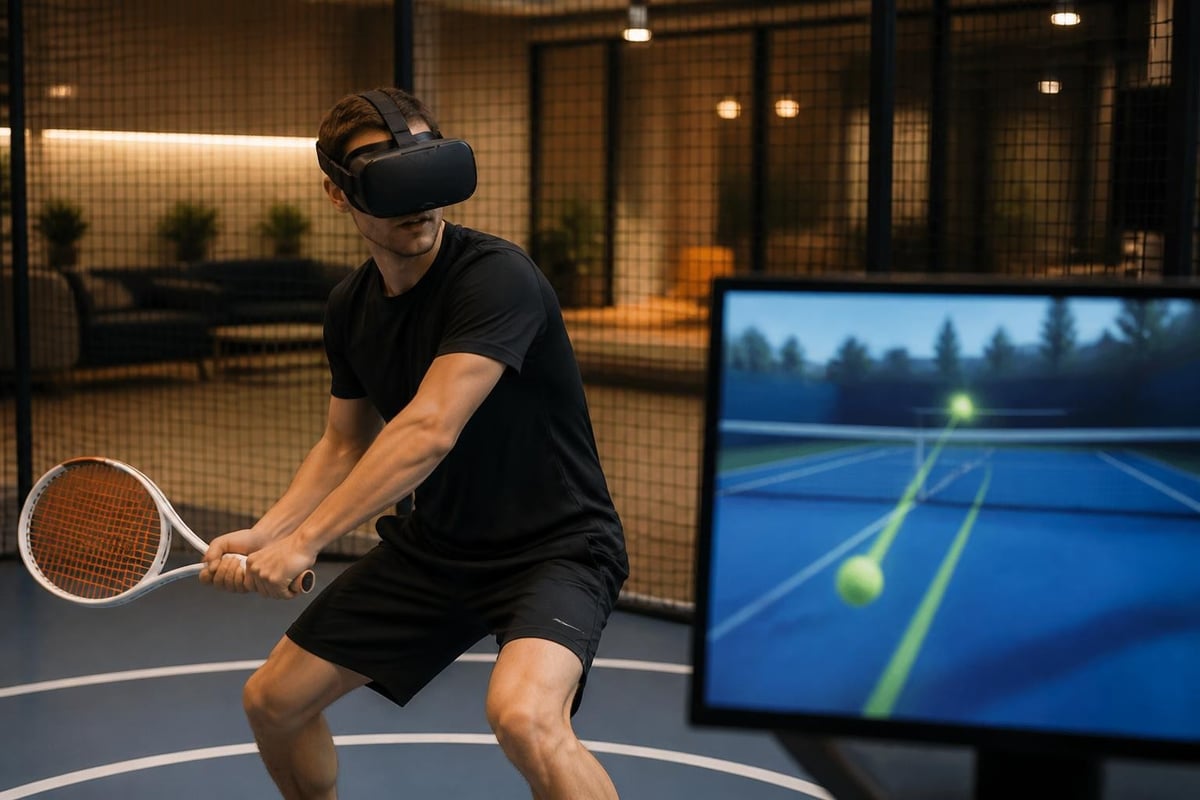
Virtual Reality Training Systems
Virtual reality tennis training platforms create immersive environments where players can practice visual tracking without physical ball constraints. These systems offer:
- Controlled ball speed progression
- Customizable spin and trajectory patterns
- Immediate visual feedback
- Repetition without physical fatigue
VR platforms allow eye coaches to isolate visual challenges while players develop muscle memory for proper tracking patterns.
AI-Powered Performance Analysis
Artificial intelligence systems for tennis training now provide detailed analysis of visual attention patterns during play. These platforms track:
- Gaze direction throughout rally sequences
- Focus duration at critical decision points
- Visual scanning patterns during point construction
- Attention allocation between ball and opponent
This data enables eye coaches to create personalized visual training programs addressing individual weaknesses with precision.
Specialized Training Equipment
Modern eye coaching incorporates equipment designed to challenge and develop visual systems. Shutter glasses research in tennis demonstrates their effectiveness for improving hand-eye coordination under visual constraints.
Additional tools include:
- Strobe light systems for peripheral awareness
- Reaction ball devices for unpredictable tracking
- Vision boards for eye movement drills
- Colored lens filters for contrast sensitivity
Integrating Eye Coaching with Technical Training
The most effective tennis development occurs when visual training complements technical instruction. An eye coach approach enhances traditional coaching by ensuring players can execute what they've learned under visual pressure.
Coordinating Visual and Physical Skills
Stroke mechanics mean little if players cannot consistently see the ball properly. The integration process involves:
- Teaching proper head positioning during stroke preparation
- Developing visual routines for consistent ball pickup
- Synchronizing eye tracking with weight transfer
- Maintaining focus through contact regardless of body rotation
Players working on advanced techniques like generating topspin on two-handed backhands must coordinate precise visual tracking with complex body mechanics for optimal results.
For tennis coaches seeking to enhance their teaching effectiveness, comprehensive tennis coaching courses provide systematic approaches to integrating visual training with technical instruction. The Tennis Method’s certification programs teach coaches how to identify visual deficiencies and implement corrective protocols that accelerate player development.

Progressive Visual Loading
Eye coaches structure training to gradually increase visual demands, building capacity without overwhelming players. This progression follows:
| Training Phase | Visual Challenge | Technical Focus |
|---|---|---|
| Foundation | Consistent feeds, single speed | Basic tracking mechanics |
| Development | Variable speeds, mixed spins | Tracking with movement |
| Competition | Multiple balls, distraction training | Match-like visual processing |
| Elite | Extreme speeds, fatigue conditions | Peak performance under pressure |
This systematic approach ensures visual skills develop in parallel with technical abilities, creating robust performance under all conditions.
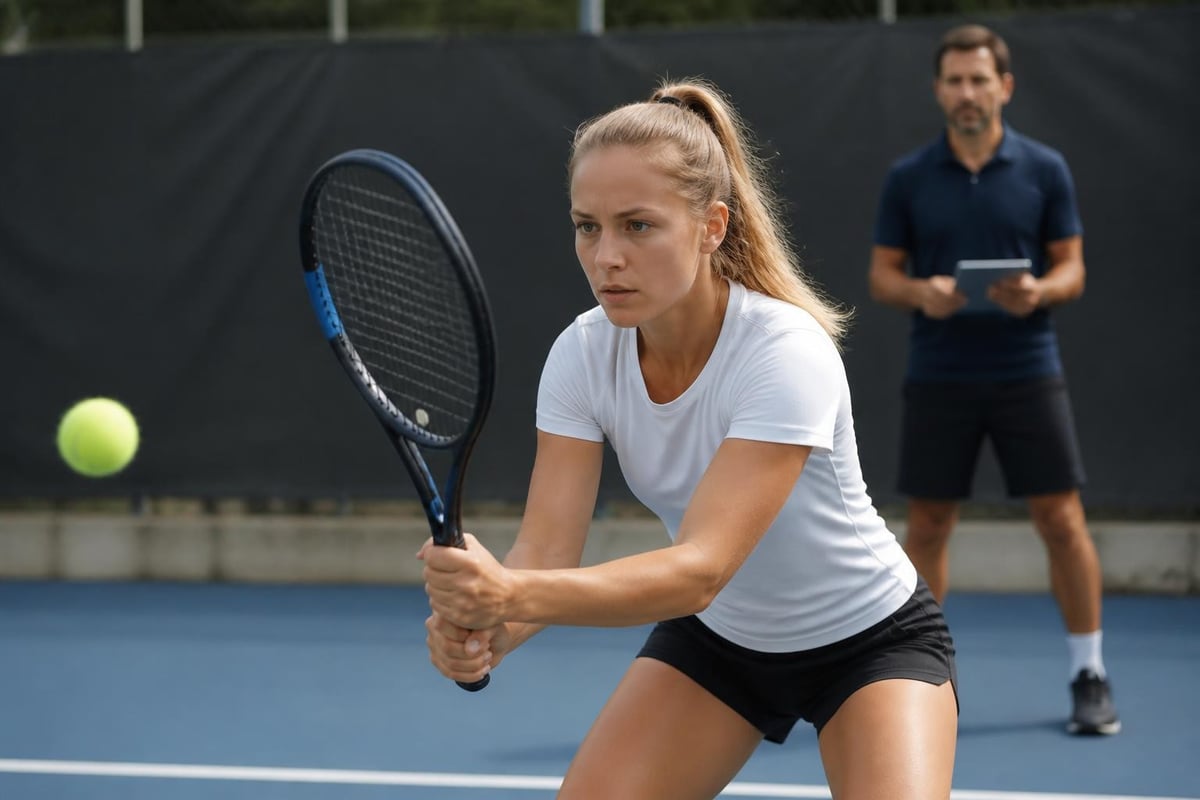
Measuring Progress in Visual Training
Quantifying visual improvement provides motivation and guides program adjustments. Eye coaches utilize both objective and subjective assessment methods.
Performance Metrics
Tracking accuracy measures how consistently players maintain visual contact throughout ball flight. High-speed video analysis reveals focus drops and tracking irregularities invisible to the naked eye.
Reaction time assessments quantify how quickly players initiate movement after visual stimulus. Baseline measurements establish starting points, with regular testing documenting improvement.
Contact point consistency serves as an indirect measure of visual success, as improved tracking naturally leads to more precise contact locations.
Subjective Feedback Integration
Players provide valuable insights about visual clarity, focus sustainability, and confidence in ball tracking. Experienced eye coaches correlate subjective reports with objective data to create comprehensive development pictures.
Regular feedback sessions address:
- Perceived visual fatigue during extended rallies
- Confidence in tracking various ball types
- Clarity of vision at different court positions
- Mental effort required to maintain focus
Understanding these elements allows coaches to adjust training intensity and recovery periods appropriately.
Common Visual Challenges in Tennis Players
Identifying specific visual weaknesses enables targeted correction. Most tennis players exhibit one or more characteristic visual patterns that limit performance.
Late Ball Recognition
Players who consistently prepare late often struggle with early ball pickup rather than slow footwork. Their eyes fail to lock onto the ball immediately off their opponent's racquet, creating cascading timing problems.
Correction protocols include:
- Opponent racquet-face awareness drills
- Early tracking cue development
- Peripheral vision expansion exercises
- Anticipatory positioning based on visual cues
Inconsistent Depth Perception
Misjudging ball depth causes positioning errors that force awkward contact points. This visual deficiency stems from:
- Inadequate binocular vision coordination
- Poor distance calibration
- Limited experience with ball speed variations
- Environmental factors affecting depth cues
Targeted depth training using varied ball speeds and trajectories recalibrates visual distance assessment over time.
Focus Sustainability Issues
Visual fatigue manifests as declining shot quality during extended rallies or late-match situations. The eyes physically tire from continuous tracking demands, reducing processing accuracy.
Building visual endurance requires progressive overload through:
- Extended rally drills with maintained focus
- Multi-ball sequences without rest
- Visual concentration exercises off-court
- Recovery protocols for visual system restoration
Resources on sports education methodology provide additional context for developing comprehensive athletic skills including visual capabilities.
Applying Eye Coaching Principles to Stroke Correction
Visual training accelerates technical improvements by enabling players to see their strokes more accurately. When combined with systematic instruction methods, visual enhancement creates rapid progress.
Visual Feedback Loops
Players must see their contact point clearly to make meaningful adjustments. Eye coaching establishes strong visual-kinesthetic connections that facilitate:
- Real-time contact point awareness
- Immediate recognition of contact errors
- Visual confirmation of successful adjustments
- Reinforcement of correct patterns
Concentration Training for Technical Work
Learning new techniques requires sustained visual attention. Eye coaching develops the concentration capacity necessary for quality practice sessions where players can maintain focus on specific technical elements for extended periods.
This concentration enhancement proves particularly valuable when players work to correct and improve topspin techniques, which require precise visual monitoring of racquet path and ball contact.
Building an Eye Coaching Practice Routine
Implementing visual training requires structured programming that fits within overall tennis development. Effective routines balance visual work with technical and physical training.
Daily Visual Preparation
Pre-practice visual activation prepares the eyes for optimal performance. A ten-minute routine might include:
- Eye movement warm-ups (horizontal, vertical, diagonal tracking)
- Near-far focusing exercises
- Peripheral awareness drills
- Concentration exercises
On-Court Integration
Every on-court drill presents opportunities for visual training. Coaches should cue players to:
- Watch the opponent's racquet during ball preparation
- Track continuously without letting eyes drift
- Focus through contact rather than looking up early
- Recover visual focus quickly between points
Recovery and Maintenance
Visual systems require recovery periods just like muscles. Off-court maintenance includes:
- Rest periods with reduced screen time
- Eye relaxation techniques to reduce strain
- Vision nutrition supporting eye health
- Regular eye examinations monitoring visual system health
Long-Term Benefits of Eye Coaching Integration
Players who develop superior visual skills early in their tennis careers build advantages that compound over time. These benefits extend beyond immediate performance improvements.
Injury reduction occurs as better tracking enables more balanced positioning and reduces awkward movements. Faster learning of new techniques follows from enhanced visual processing. Extended career longevity results from reduced visual system strain and more efficient movement patterns.
The eye coach methodology represents a frontier in tennis development that separates good players from exceptional ones. By training the visual system as deliberately as strokes and fitness, players unlock performance levels previously inaccessible through traditional training alone.
For comprehensive technical development that complements visual training, players can explore proven online tennis coaching programs that integrate multiple performance dimensions systematically.
Developing elite visual skills through eye coaching principles transforms tennis performance by addressing the critical connection between what players see and how they execute. Whether you're a competitive junior, serious recreational player, or aspiring coach, integrating visual training accelerates improvement and builds consistent performance. Tennis Method Mili Split (MSM) combines cutting-edge visual training concepts with the revolutionary Split Method to deliver guaranteed technical corrections and rapid skill development, even through online coaching formats.