
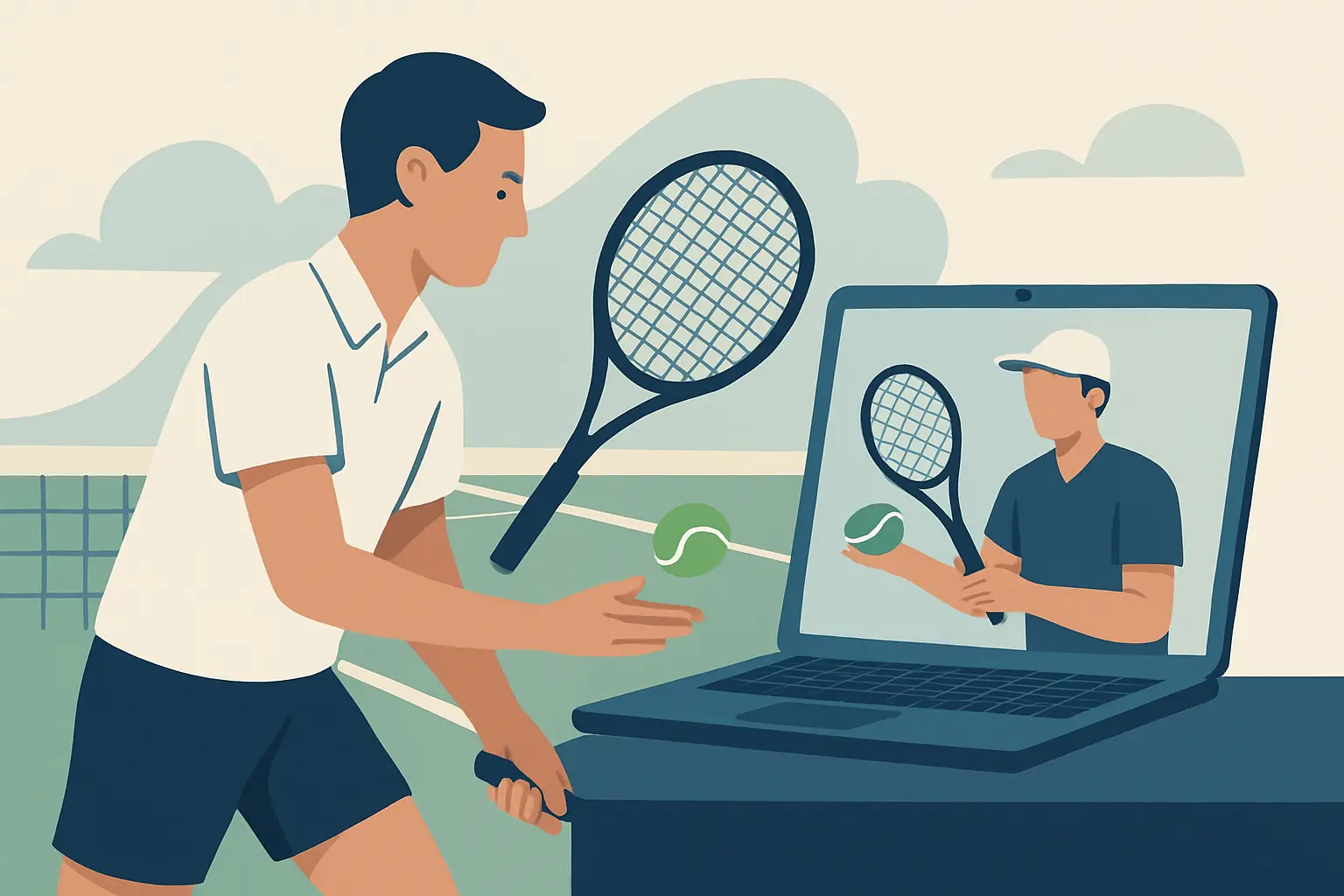
You don’t need more tips. You need a coach who can look at your forehand or backhand, spot the one mistake that keeps repeating, and give you a correction you can actually execute on the next ball.
That is the real dividing line in online tennis coaching. The “best” programs are not the ones with the most videos or the fanciest app. They are the ones that produce clean, repeatable strokes under pressure because the program is built around diagnosis, feedback, and a method that holds up when the ball gets heavy.
What “best” really means in online tennis coaching
Online coaching gets judged unfairly because people compare it to in-person lessons and assume it has to be worse. That’s not automatically true. If a program is built correctly, online coaching can be more efficient than a weekly lesson because it forces clarity: clear video angles, clear priorities, clear checkpoints, and clear accountability.
The best online tennis coaching programs do three things consistently.
First, they don’t drown you in theory. They identify the highest-impact flaw and fix that first. Second, they give you feedback that is specific enough to act on in one session. “Good job” is not feedback. “Your contact is late because your first move is a backswing, not a turn” is feedback. Third, they create a progression that holds up when you change variables – speed, spin, direction, and stress.
If a program can’t do those three things, it may still be entertaining. It will not be reliable.
Why most players fail with online programs
Most players are not lazy. They are overloaded. They watch one video about wrist lag, another about unit turn, another about spacing, then they try to apply all of it at once. The result is predictable: stiff swings, confused timing, and a stroke that only works during easy rally balls.
The other common failure is self-diagnosis. Players film themselves, compare to a pro, and chase surface details. Pros look smooth because the sequence is correct. You don’t copy “smooth.” You build the sequence.
A good online program prevents both problems. It limits your focus, tells you exactly what to look for, and gives you a simple way to measure if the change is working.
The best online tennis coaching programs have these features
Real technical feedback, not just a library
A video library is not coaching. It’s education. Education can help, but it doesn’t fix your stroke by itself.
The best programs include personalized analysis – ideally with a coach who has a consistent method, not a new opinion every week. You should feel like the coach is standing behind you on court because the feedback is that precise.
Look for programs that ask for specific angles (side and behind), specify what to film (crosscourt forehand, backhand, serves if included), and return feedback with priorities. One or two corrections that change everything beat ten small notes that change nothing.
A method, not a mood
Some coaching depends on the coach’s personality. That is fine for motivation, but it is unreliable for skill building.
The best online tennis coaching programs are built on a repeatable method. That method should describe how the stroke is organized, what causes the most common breakdowns, and what correction sequence gets players back on track fastest.
If a program can’t explain its system in plain English, it is usually improvising.
Short feedback loops
Online works when the loop is tight: you submit video, you get feedback quickly, you apply it, and you submit again. Long delays kill momentum. If you have to wait two weeks to learn whether you did the correction correctly, you will cement the wrong version.
If the program offers unlimited messaging but takes forever to respond, the “unlimited” part doesn’t matter.
Drills that transfer to points
Some drills make you feel better. The best drills make you win more points.
A strong program uses drills that build timing and contact under realistic constraints – targets, rhythm, and directional control – not just slow-motion swings in the living room. At minimum, it should give you a plan for how to hit with a partner, a ball machine, or simple self-fed progressions.
Clear standards for success
Online coaching gets vague when programs avoid accountability. The best programs define success in observable terms: contact position, ball shape, depth, consistency, and the ability to repeat under moderate pace.
This matters because it eliminates the emotional guessing game of “I think it’s better.” You either hit the standard or you don’t. That is how real improvement happens.
Picking the right program depends on your goal
Not every player needs the same solution. “Best” depends on the problem you are solving.
If you are a beginner, you need structure and simple fundamentals that prevent bad habits. You should prioritize programs that teach grips, contact, spacing, and swing direction in a tight progression.
If you are an intermediate player, you need diagnosis and correction. At this stage, most problems are not effort problems – they are sequence problems. The best program for you is the one that finds the one broken link and fixes it without rebuilding your entire game.
If you are an advanced competitor, you need refinement under speed and stress. You should look for coaching that addresses shot tolerance, patterns, and technical reliability when your feet are late and your opponent is pushing you.
And if you are a coach, “best” means something different. You need a system you can apply across different body types, ages, and learning styles. You also need language that produces results fast, because your players do not pay for long explanations. They pay for change.
What to ask before you commit
Before you pay for any online coaching program, ask direct questions. A serious program will answer clearly.
Ask how feedback is delivered. Is it written notes, voiceover on your video, live calls, or a mix? Voiceover is often best because you see exactly what the coach means.
Ask what the timeline looks like. Be cautious with programs that promise nothing and also cautious with programs that promise everything. A trustworthy coach can tell you what improves fast (cleaning up contact and swing path) and what takes longer (movement habits and competitive decision-making).
Ask how many swings you will need per week. A program that requires six days a week may be great for a junior in training and unrealistic for an adult with a job. Consistency beats intensity when the plan is correct.
Ask what happens if you plateau. The best online tennis coaching programs have a built-in adjustment process, not just “keep doing the drill.” Plateaus are usually a sign that the constraint needs to change – pace, target size, footwork demand, or a correction that has to be simplified.
Red flags that waste your time
If a program sells you on celebrity endorsements but can’t describe its feedback process, you’re buying marketing.
If the program tries to fix every part of your game at once, you will feel busy and stay the same.
If it relies on complicated jargon to sound smart, it is probably hiding that it doesn’t have a clean method.
And if it makes you feel like improvement is mysterious, run. Tennis is hard, but good coaching is not confusing.
Where guaranteed results fit in
Guarantees make people uncomfortable because they’ve been burned by vague promises before. But a guarantee can be legitimate when the program controls what matters: a specific method, specific checkpoints, and a specific process.
The trade-off is that guarantees usually apply to a narrow, well-defined outcome. That’s a good thing. “Fix your groundstrokes” is broad. “Correct the technical cause of your forehand and backhand breakdowns through a step-by-step method” is precise.
When you see a guarantee, read what it actually covers and what it requires from you. If the program demands clear video, honest effort, and following the progression, that’s not fine print. That’s the deal.
One example of a program built around a defined method and a results-driven promise is [Mili’s Split Method](https://tennismethod.com), designed to correct groundstroke issues fast with a system that translates cleanly to online coaching because it is taught in a specific, repeatable way.
How to get the most out of any online tennis coaching program
Online coaching rewards players who treat it like training, not content.
Film with discipline. Use the same angles each time, and don’t cherry-pick your best swings. Your coach needs your normal ball, including the miss.
Stick to the priority. If your coach gives you one correction, do not add three more from a video you watched later. Give the correction enough reps to stabilize.
Train with intent. Don’t just hit. Set a target, track a simple metric (like 20 crosscourts in a row past the service line), and make your sessions measurable.
And pressure-test early. Once the swing feels better in a cooperative rally, add pace, add movement, and add a point start. A program is only as good as its transfer to real tennis.
The programs that win are the ones that simplify
Players improve fastest when the plan gets simpler, not more complicated. The best online tennis coaching programs remove noise, lock in the sequence, and give you feedback that makes the next ball better.
Choose the program that is obsessed with outcomes, not content. Then do your part with consistency for a few weeks and let the method do what it is designed to do.
Your next level is not hiding in a new racket or a new tip. It’s in one clean correction, repeated until it’s yours.