
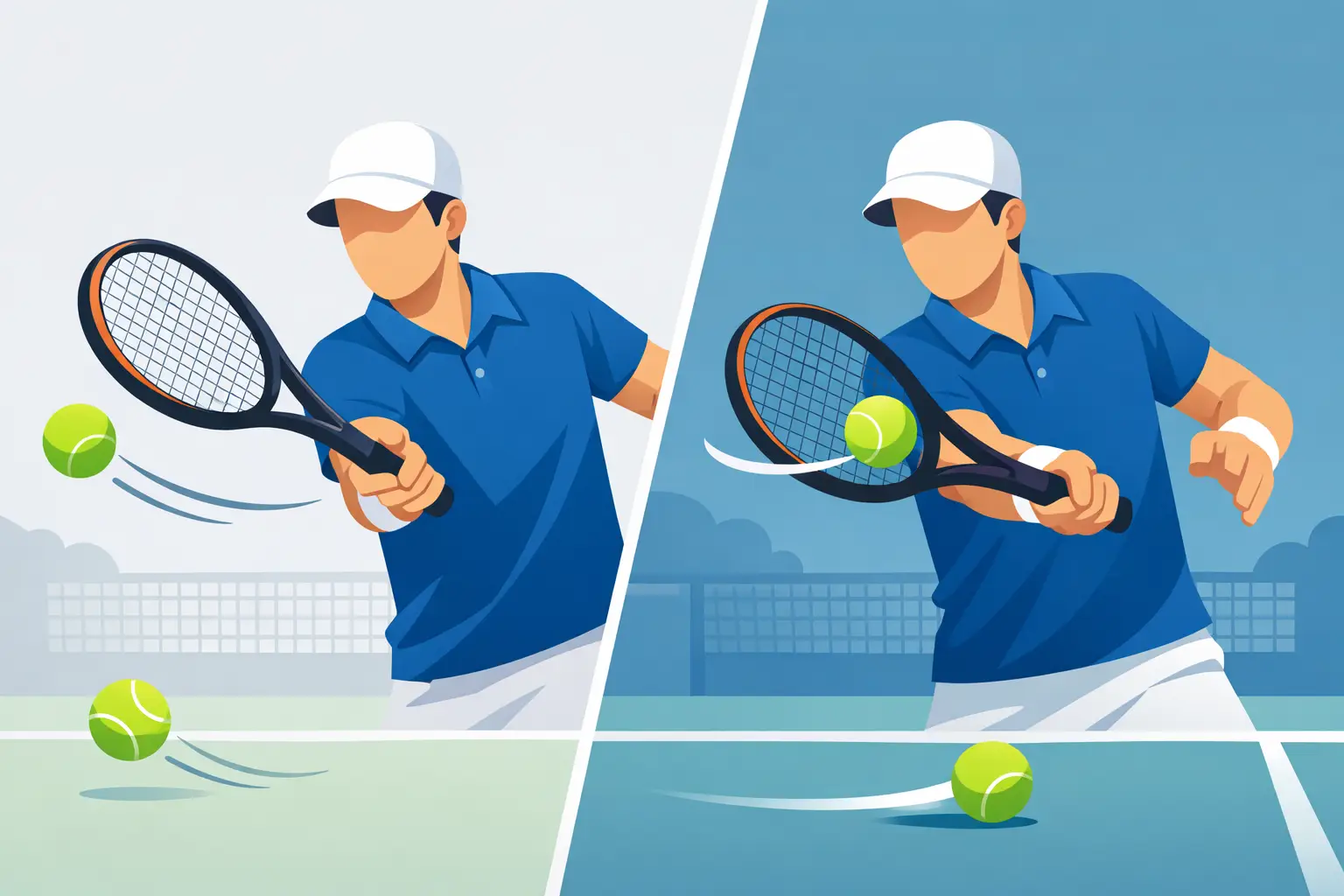
That forehand shank usually shows up the same way – the ball catches the frame, flies sideways, and your confidence drops for the next three points. If you are searching for how to stop shanking tennis forehand, you do not need more vague advice about “watching the ball.” You need to fix the exact breakdown that causes the mishit.
A shanked forehand is not random. It comes from a small set of technical errors that repeat under pressure. Once you identify which one is happening, the miss becomes fixable fast.
Why players shank the forehand
Most forehand shanks happen because the racket face and the ball are not meeting at the intended contact point. That sounds obvious, but the reason behind it is usually one of three things: bad spacing, late timing, or a broken swing path.
Spacing is the biggest one. When the ball gets too close to your body, your arm has no room to extend into clean contact. The racket drifts inward, the frame leads, and the ball catches the wrong part of the strings. When the ball is too far away, the same result happens for the opposite reason – you reach, lose structure, and the contact point moves away from where it should be.
Timing is next. A forehand struck late often produces a shank because the racket is still traveling into position when the ball arrives. You are not actually set at contact. Players often think they need a bigger backswing or more effort, but the real fix is earlier preparation and better footwork.
Then there is swing shape. If the racket comes too steeply across the ball, or if the hand gets disconnected from the body, the contact point becomes unstable. That instability shows up even more against pace, on high balls, and when returning wide shots on the run.
How to stop shanking tennis forehand by fixing spacing
If you fix spacing, you often fix the shank immediately.
The forehand needs a consistent distance between your hitting shoulder, your hand, and the incoming ball. That distance is created with your feet, not with a last-second arm adjustment. Strong players do not “find” the ball with the racket. They move their body so the contact point appears in the same place again and again.
Start by noticing where the shank happens. If it mostly occurs on medium-paced rally balls, you are likely crowding yourself. If it happens on wide balls, you are probably reaching and losing balance. Both are spacing issues, but the correction is different.
When you crowd the ball, create more room by using small adjustment steps just before contact. One big move gets you close. The last two or three small steps put you in the right spot. This is where many players fail. They move to the ball, then stop moving too early. The ball keeps traveling, your spacing changes, and the racket frame gets involved.
When you reach too far, resist the urge to lean with your upper body. Move your base first. If you cannot get fully set, then shorten the swing and prioritize solid strings contact over topspin or power. There is no value in attempting a full forehand from a bad position if it produces a frame shot.
The fastest spacing check
Freeze your finish after a clean forehand and after a shank. On the clean ball, you will usually feel balanced, with enough room for your arm to extend naturally. On the shank, you will often feel jammed, pulled, or stretched. That feeling tells the truth fast.
Timing errors that create frame contact
A late forehand is a shank waiting to happen.
Players often blame the racket or the grip when the real problem is simple: preparation starts too late. By the time the ball enters the strike zone, the racket is still catching up. That is why the contact feels rushed and unstable.
The correction is decisive. Turn earlier. Set the hitting arm sooner. Let the racket travel from a prepared position instead of building the stroke at the last second.
This matters even more against faster hitters. The harder the incoming ball, the less backswing you need and the earlier you must organize. Good timing is not about swinging faster. It is about being ready earlier.
Use the bounce as your trigger
A reliable pattern is this: unit turn as the ball leaves your opponent’s racket, and complete your main preparation by or just before the bounce. If you are still taking the racket back after the bounce, you are late for many rally situations.
That one adjustment solves a surprising number of forehand shanks because it gives you time to space correctly and strike out in front instead of beside your body.
Check your contact point, not just your swing
Many players work on the look of the swing and ignore the location of contact. That is backwards.
A clean forehand contact point is usually slightly in front of the body, at a comfortable distance from the hip, with the chest helping support the strike. When contact drifts too far back, the racket face becomes harder to control. When it drifts too close, you jam yourself. In both cases, the frame becomes a real possibility.
If you want a direct fix, practice calling out “front” at contact during easy rallies. It sounds simple because it is. But it forces your awareness to the place that matters most.
This is also where grip and ball height matter. An extreme grip on a low ball can make clean contact harder if your spacing is already poor. A higher ball gives you more margin for topspin, but only if your body position supports it. The answer is not changing everything at once. Fix contact location first, then evaluate whether your grip and swing pattern support that location.
The swing path mistake that makes shanks repeat
If your racket path cuts too sharply across the ball, the margin disappears.
A modern forehand does move up and across, but it still needs extension through the contact zone. Players who shank repeatedly often pull off the ball too early. Their torso opens fast, the arm wraps across, and the racket never spends enough time traveling through the line of the shot.
That creates glancing contact instead of solid contact.
The solution is not a stiff arm or a flat push. It is a connected swing where the body rotates, the hand stays organized, and the racket extends through the strike before wrapping naturally. This is one reason structured teaching works better than random tips. You need the sequence right, not just one cue.
A simple practice progression that works
If you want to stop shanking, do not start with live points. Build clean contact first.
Begin with self-drop forehands from the service line. Focus on one target, one contact point, and balanced spacing. If you shank here, the problem is purely technical. That is useful because it removes the excuse of speed.
Then move to hand-fed balls at moderate pace. Keep the same contact point and spacing. If the shank appears only now, your setup and footwork need work.
After that, rally crosscourt at reduced speed. Finally, increase pace and direction changes. This progression exposes the real weakness in order. It is fast, honest, and much more effective than trying to fix everything during match play.
At Mili’s Split Method, this kind of precise correction is why players can clean up major groundstroke issues quickly. The result does not come from hitting thousands of random balls. It comes from identifying the exact fault and correcting it with a repeatable method.
What players get wrong when trying to fix the shank
The biggest mistake is chasing symptoms. Players tape the racket differently, change strings, switch grips, or try to swing slower. Sometimes that reduces the miss for a day, but the real issue remains.
Another mistake is overcorrecting. If you got jammed, you may start standing too far away. If you were late, you may rush every ball and lose rhythm. If you were too rotational, you may freeze the body and lose racket speed. Good correction is specific. It solves the actual fault without creating a new one.
It also depends on the ball you are receiving. A heavy topspin forehand that jumps into your body requires different spacing than a lower, skidding ball. A high incoming pace requires shorter preparation. A wide emergency ball may need a defensive forehand, not your standard rally swing. Strong players adjust while keeping the contact principles intact.
How to know your forehand is improving
You are improving when the mishits stop showing up on neutral rally balls first. Then your contact becomes cleaner under pace. Then you can handle awkward heights and wider balls without panic.
Listen to the sound. Clean contact has a consistent sound. Frame contact does not. Feel your balance after the shot. A stable finish usually means your spacing and sequence were right. Most of all, track patterns. If every shank happens on balls into your body, the diagnosis is clear. If they happen when you are rushed wide, the solution is different.
The forehand shank is not a mystery and it is not something you have to tolerate. It is a technical error with a cause, and once you train the cause correctly, the clean strike starts to feel normal again. That is when confidence comes back – not from hoping the next ball lands on the strings, but from knowing why it will.