
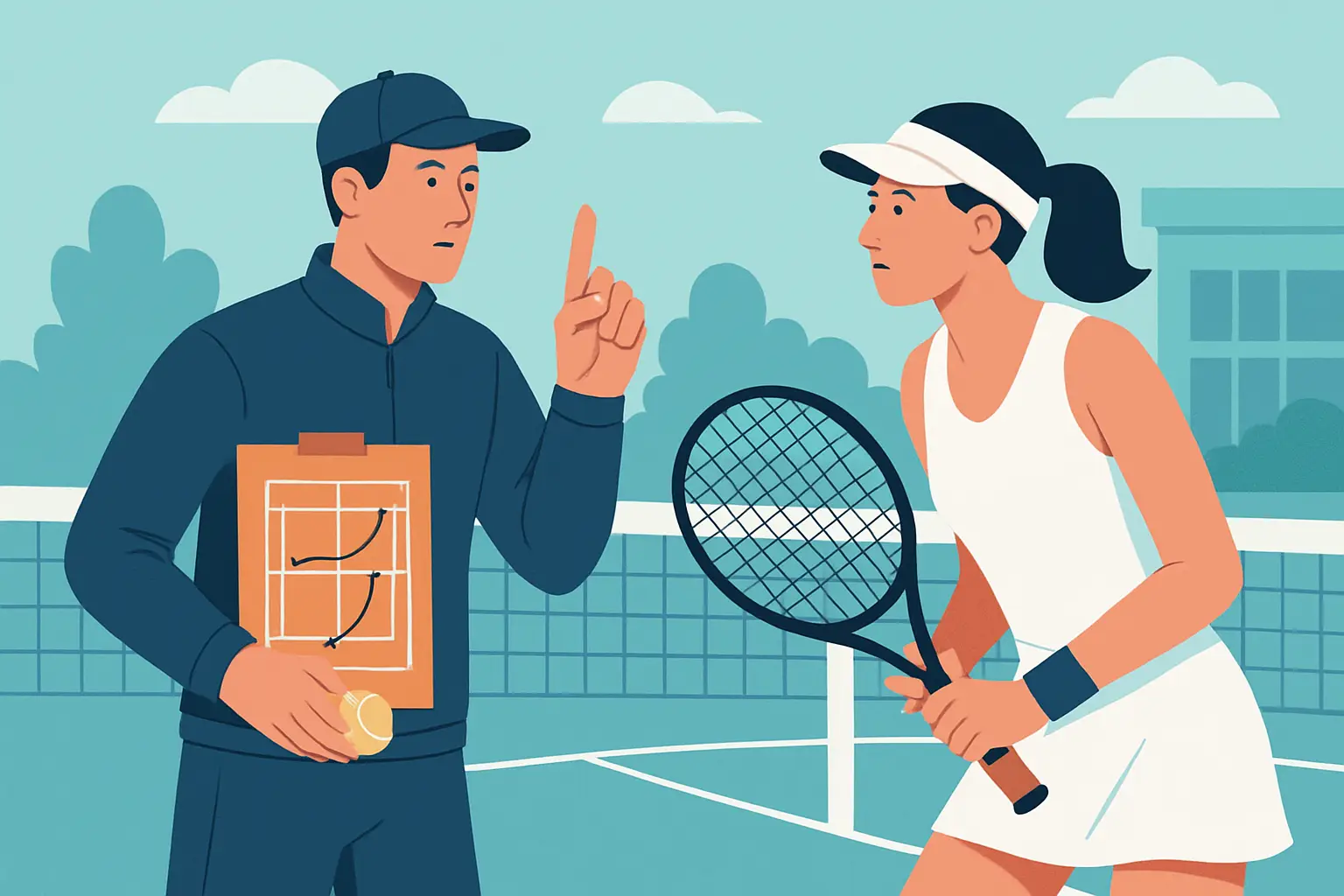
The fastest way to spot a real coach is simple: they can change a player’s ball in minutes, not months. Not with motivational speeches or vague “swing faster” advice – but with precise technique, a repeatable correction, and a feedback loop that holds under pressure.
A lot of players and coaches waste time because they treat groundstrokes like a personality trait. “That’s just my forehand.” No. Your forehand is a chain of positions and timings. Change the chain and the ball changes.
This article breaks down professional tennis coaching techniques that reliably produce cleaner forehands and backhands, especially when the goal is fast, measurable improvement.
What “professional tennis coaching techniques” really mean
At the pro level, coaching technique is less about having more tips and more about having better priorities. The best coaches organize everything around three outcomes: contact quality, directional control, and repeatability under pace.
If a correction doesn’t improve at least one of those outcomes quickly, it’s usually noise. Pros do not collect cues. They install patterns.
That leads to a trade-off you need to accept upfront. When you coach for speed, you sacrifice variety in the beginning. You lock in a base pattern first, then you add options. Coaches who try to build “all the shots” at once typically create a player who owns none of them.
The pro-level coaching sequence: ball first, then body
Most recreational coaching starts with the body: grip, stance, unit turn, elbow, wrist. Pro coaching usually starts with the ball, because the ball is the truth.
A professional coach looks at three things immediately: the height and distance of contact, the ball’s launch angle (net clearance), and the miss pattern. Those three tell you whether the problem is spacing, racket face control, or timing.
Then the coach works backward to the body. That’s not “less technical.” It’s more efficient.
A practical diagnostic that saves weeks
If a player is late, many coaches tell them to “prepare earlier.” That’s generic. A pro coach checks whether the player’s contact is drifting behind the hip because of slow preparation, or because the player is crowding the ball and jamming the swing.
Same symptom, opposite fix. One needs earlier turn. The other needs better spacing and a clearer contact point. This is why pros diagnose with ball-flight and contact location, not with guesswork.
One change at a time – but make it a big change
One of the most misunderstood professional tennis coaching techniques is constraint-based coaching. It’s not random games. It’s forcing the swing to self-correct by changing the environment.
Instead of delivering ten instructions, a pro coach will often:
- alter the feed (height, speed, spin)
- change the target (bigger margin, tighter lane)
- restrict the task (only crosscourt, only heavy topspin)
- manipulate spacing (markers, cones, or a simple “don’t step inside this line” rule)
That creates a clean cause-and-effect: the player feels what works because the ball rewards it immediately.
The trade-off is that constraint drills can look “too simple” to people who equate complexity with expertise. Pros don’t care how it looks. They care if it transfers.
The contact point is the real coach
If you want the fastest groundstroke improvement, you coach the contact point like it’s a non-negotiable.
For forehands, the pattern that holds up is contact out in front with a stable racket face through impact. For backhands, it’s the same principle, with less tolerance for late contact and more dependence on clean spacing.
When players miss, they usually blame the swing path. In reality, the contact point moved.
A professional coach constantly calibrates contact with three simple questions:
Is the player meeting the ball at the same distance from the body every time?
Is the ball being struck at a consistent height window?
Is the player’s balance allowing the racket face to stay predictable?
Fix those, and “technique” becomes easier because the body organizes around the strike.
Timing beats mechanics when pace goes up
At higher speeds, mechanics don’t disappear – but timing dominates. This is why pro coaching spends so much time on rhythm.
A strong coaching cue is not “bend your knees.” It’s “load as the ball rises, strike as it falls.” A strong cue is not “finish higher.” It’s “match the bounce and don’t chase it.”
These are timing instructions that automatically clean up mechanics.
The split-step and first move are stroke technique
Many players separate footwork and strokes. Pros don’t.
Your split-step timing decides whether you arrive early enough to swing freely. Your first move decides whether you’ll create space or get jammed. That’s why professional tennis coaching techniques treat footwork as part of the swing, not a warm-up category.
If you want fast improvement, coach the first two steps after the split-step as aggressively as you coach the grip.
Short feedback loops: video, measurable targets, and correction reps
Pros improve quickly because their feedback loop is tight.
A typical recreational loop looks like this: hit for 30 minutes, talk for 3 minutes, repeat next week. A pro loop looks like: attempt, immediate feedback, immediate adjustment, immediate retest.
Video is part of that, but only when used correctly. The point of video is not to create a highlight reel of flaws. It’s to confirm one thing: did the correction change the position that matters at contact?
Targets also matter. Not “hit it in.” Real targets. If you can’t measure it, you can’t own it.
For example, for a player who sprays forehands long, a pro coach will often raise the required net clearance and demand a deeper target window. That forces a safer launch angle and removes the player’s need to guide the ball. Then, once the shape is stable, the coach tightens the target.
The pro cue hierarchy: external, then internal
If you want to coach like a pro, stop leading with body-part commands.
The best cues are usually external and ball-based: “clear the net by three feet,” “finish with the strings facing the side fence,” “drive through that lane.” These cues produce automatic coordination.
Internal cues (elbow here, wrist there) have a place, especially during a rebuild. But they are slower under stress. Under match pressure, players can’t run a checklist of joints.
A confident coaching system uses internal cues to install a pattern, then shifts to external cues to make it durable.
Teaching progression that actually holds up
Here’s a truth that experienced coaches know: some players look great in a slow rally and fall apart the second you add pace. That’s a progression failure.
A professional progression usually goes:
First, stabilize contact on controlled feeds.
Then, add movement without adding pace.
Then, add pace without adding decision-making.
Finally, add decision-making (live points) while keeping the technical demand simple.
If you reverse that and jump to live points too early, you train survival tennis. The player learns to block, flick, and improvise – and the original flaw stays untouched.
Coaching the miss pattern, not the highlight
Pros don’t chase the player’s best shot. They chase the player’s most common miss.
If the backhand breaks down into the net, a professional coach doesn’t talk about “confidence.” They treat it as a face and path issue created by spacing, timing, or a collapsing hitting structure. Then they pick the correction with the fastest payoff.
If the forehand sprays wide, they don’t say “rotate more.” They ask whether the player is opening the face early, pulling off balance, or contacting too close. Different causes, different solutions.
That’s how you get rapid progress: you don’t coach what you saw once. You coach what happens most.
When a rebuild is the right call (and when it’s not)
Some technical problems can be patched. Others have to be rebuilt.
If a player can rally, compete, and the flaw shows up only under maximum pace, you often build a match-ready workaround first, then rebuild in the off-season.
If the flaw is structural – for example, a contact point that is consistently behind, or a swing shape that cannot produce safe net clearance – then patching is just delaying the inevitable. A rebuild is the professional decision.
This is where coaching confidence matters. Players can sense when a coach is guessing. A clear rebuild plan with tight reps and instant feedback creates trust.
Online coaching that feels like you’re on court
A lot of coaches still treat online lessons like “send me a clip and I’ll send you notes.” That’s not professional level. Pros coach in real time: they observe, prescribe, confirm.
The best online coaching uses the same structure as on-court coaching: one correction, one drill to force it, one measurable target, one retest on a harder ball.
That’s also where specialized systems separate themselves. For players and coaches who want a method built specifically to correct groundstrokes fast, Mili’s Split Method is designed around rapid technical change, with a clear process and a guarantee that reflects real certainty.
What to demand from your next coaching session
If you’re a player, you should leave a great session with one clear improvement you can feel and reproduce. If you’re a coach, you should be able to explain exactly what changed and why it changed, without hiding behind “we’ll see how it goes.”
The standard is not whether the player hit a few good balls. The standard is whether the correction survives the next level of difficulty: more speed, more movement, more pressure.
That’s what makes professional tennis coaching techniques professional. They don’t rely on luck, mood, or perfect conditions. They create repeatable ball quality on demand.
One helpful thought to take to your next practice: don’t chase ten fixes. Chase one change that the ball immediately confirms, then let repetition turn it into a weapon.