
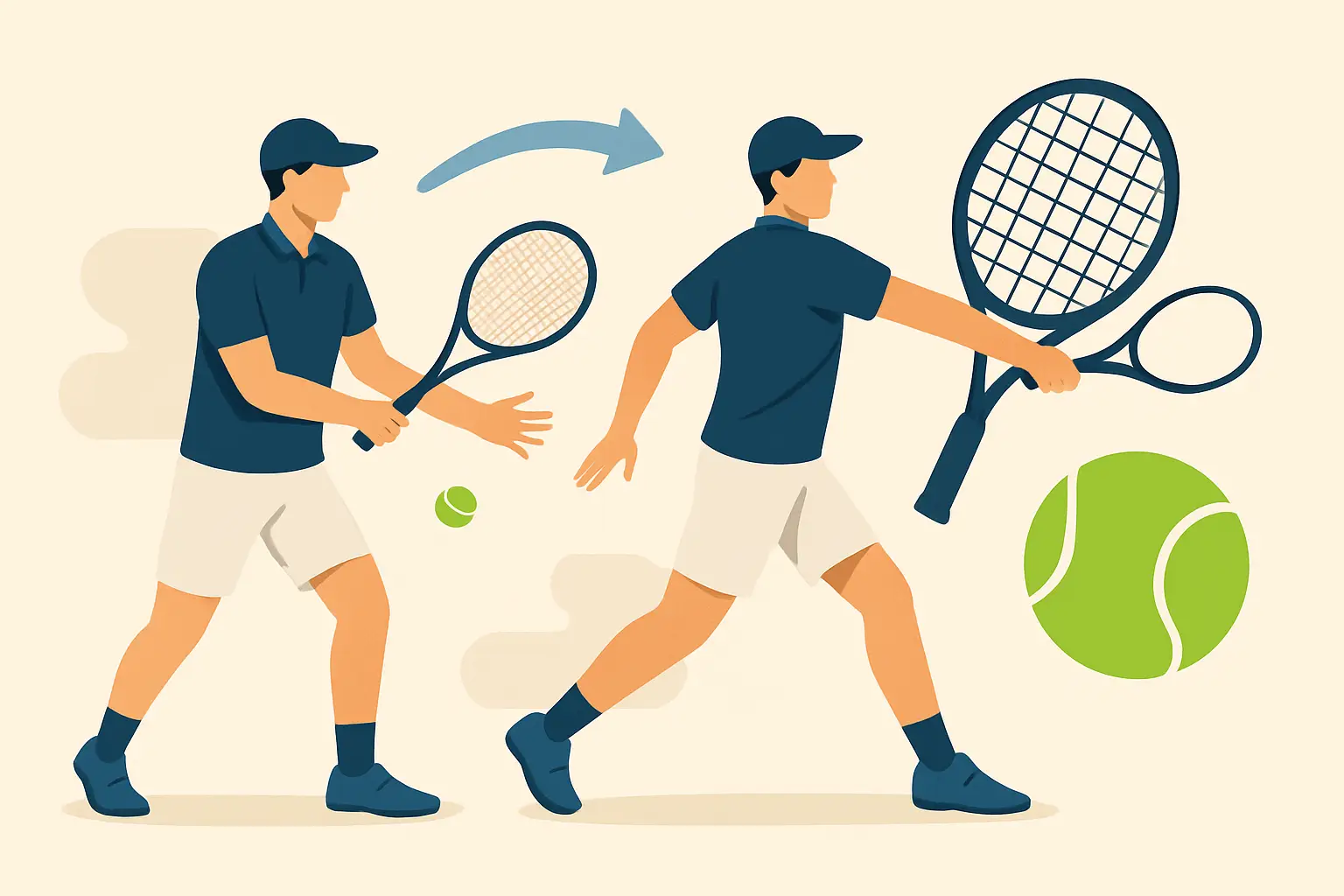
You know the moment. The ball is slow, you have time, and you still miss – because your stroke shows up on autopilot. That is the real problem with most “fix my forehand” advice: it assumes you can think your way out of a movement you have repeated thousands of times.
A true tennis stroke change in three days is possible, but only under one condition: you stop negotiating with your old pattern and you install a new one with rules that your body can execute under stress. Three days is not about collecting tips. It is about replacing a motor program.
What “three days” really means in stroke change
Three days is enough time to rebuild a forehand or backhand if the work is specific, high-repetition, and tightly constrained. It is not enough time if you are experimenting, switching cues every 10 minutes, or practicing at random speeds with random feeds.
The trade-off is simple. Fast change requires structure. You give up freedom early so you can gain consistency later. Players who insist on “feeling it out” usually protect their old stroke – and then they call it a plateau.
The other non-negotiable is feedback. You cannot rely on feel because feel is calibrated to the mistake. A player with an open face at contact often feels “square.” A player who arm-slaps the ball often feels “smooth.” If you want speed, you need clarity.
Why most stroke changes fail (even with lots of lessons)
Most players do not fail because they lack effort. They fail because they train the wrong variable.
They chase outcomes: more topspin, more power, more accuracy. But outcomes are downstream. A stroke is a chain: split timing, spacing, loading, swing path, contact, and finish. If one link is wrong, the ball can still go in sometimes, which is exactly why the bad pattern survives.
Three classic failure points show up in almost every “I tried to change my stroke” story:
First, players practice the new move slowly, then they rally normally and the old move returns. That is not a mystery. Under speed, the nervous system chooses the most familiar solution.
Second, players get ten different cues from ten different sources. The body cannot commit when the rules change every day.
Third, they never lock the change under pressure. They look good in cooperative drills, then fall apart on the first tight set. Practice that does not include pressure is not practice – it is rehearsal.
The three-day framework that actually holds up
If you want a tennis stroke change in three days, your plan must do three things in order: isolate the exact technical cause, install a repeatable pattern, and then pressure-test it until it survives.
That is the whole game. Here is what each day needs to accomplish.
Day 1: Diagnose and delete the real error
Day 1 is not “hit a bunch of balls and hope.” Day 1 is surgical.
You identify the one problem that causes the cascade. For many players it is not the swing itself. It is the timing of the split step and the first move to the ball. When the split is late, the spacing is late. When spacing is late, the swing gets rushed. Then the arm takes over and the contact point drifts.
You also pick a single primary constraint – one rule that makes the old stroke impossible.
Examples of constraints that work:
If your contact is consistently late, you set a constraint that forces earlier spacing, such as starting the forward move sooner relative to the bounce.
If you roll your wrist and flip, you constrain the finish and the face stability through contact.
If your backswing gets too big, you constrain the takeback size and tempo.
You are not trying to “play better.” You are trying to make the old pattern uncomfortable and the new pattern inevitable.
This is the day where video matters. Not for vanity. For truth. Two angles is enough: behind the baseline and from the side. You are looking for proof, not style.
By the end of Day 1, you should have one sentence that explains your miss. Not five sentences. One.
Day 2: Build the new stroke with volume and clean reps
Day 2 is installation day. You do not dabble. You repeat.
The most efficient way to create fast change is to keep the feed simple enough that you can stack correct reps. Hand feeds, drop feeds, or controlled ball machine feeds work well. Live rally is allowed only if it stays within the constraint and does not trigger panic.
This is where many ambitious players sabotage themselves. They “test it” too early. They want to rip crosscourt at full speed because it feels like progress. But testing before installation just re-strengthens the old circuit.
On Day 2 you focus on three things:
Timing: your split step and your first move must match the ball’s flight so you arrive early, not exactly on time.
Spacing: you need a consistent contact zone. If your contact point drifts, your swing will drift.
Face control: the racquet face at contact is the truth serum. If the face is unstable, the ball will tell on you.
Do not confuse “more topspin” with “better mechanics.” Many players add spin by brushing late and lifting with the arm. That is not topspin you can trust. The goal is a repeatable contact with a predictable face and path.
If you want the fastest learning curve, you measure success by how often you hit the intended contact, not by how hard the ball goes.
Day 3: Pressure-test it until it’s yours
Day 3 is where your stroke either becomes real or becomes a practice-only trick.
Pressure testing does not mean playing a match and hoping. It means you deliberately create the situations that used to break your technique and you keep the constraint intact.
You add speed. You add movement. You add decision-making. Then you add scoring.
A simple progression works:
Start with faster feeds to the same location.
Then add side-to-side patterns that force spacing under movement.
Then add random feeds so you cannot pre-plan.
Finally, play points with a rule that keeps your new stroke honest. For example, you may only start points crosscourt to your target, or you may only allow yourself a certain margin.
Here is the trade-off again. Your level may drop briefly on Day 3. That is normal. You are choosing long-term reliability over short-term comfort. The player who refuses to look “worse” for a day usually stays the same for a year.
What you should feel when the change is working
Players ask for “the right feel,” but feel is personal. What matters is the pattern of feedback.
When the change is working, three things show up:
Your misses get cleaner. Instead of random shanks, you miss in a predictable direction.
You stop making emergency swings. The ball slows down visually because you are early.
Your contact sounds consistent. The sound of clean contact is not poetic. It is diagnostic.
If you are still missing every direction, still surprised by pace, and still improvising at the last second, you have not installed a new stroke. You are still negotiating with the old one.
The difference between “quick fix” and permanent change
A quick fix is a cue that helps for an hour. Permanent change is a system that survives bad days.
A real three-day change is permanent when:
You can reproduce it at the start of a session without warming up for 30 minutes.
You can hit it when you are tired.
You can hit it when you are late once or twice and still recover, because the fundamentals are stable.
If the change disappears the moment you feel pressure, that is not failure. It is information. It means you did not pressure-test enough, or your constraint was not strong enough to block the old pattern.
Coaching that feels like the court, even online
The fastest stroke changes happen when instruction is specific and accountability is built in. That is why the delivery matters as much as the content. Online coaching fails when it becomes generic tips and delayed feedback.
The reason players stick with a method is simple: they can feel that it works immediately, and they can prove it with ball flight and repeatability. A structured approach like [Mili’s Split Method](https://tennismethod.com) is built around that standard – tight constraints, fast correction, and a guarantee because the process is measurable.
Who should not attempt a three-day stroke rebuild
Three days is ideal when the problem is technical and repeatable: late contact, unstable face, inconsistent spacing, or a timing issue that throws off the chain.
Three days is not the best tool when the issue is injury-related, when pain changes your mechanics, or when you are in the middle of heavy competition with no space to absorb a temporary dip. In those cases, you still need a plan – but you may need to phase the change so you can compete while rebuilding.
Also, if you are the type of player who refuses constraints and only wants “one more tip,” do not waste the three days. The method will work, but only if you let it.
The standard you should hold yourself to after Day 3
After three days, you do not need perfection. You need ownership.
Ownership means you can explain your new rule in one sentence, you can demonstrate it on command, and you can keep it when the ball speeds up. If you have that, you have the rarest thing in tennis improvement: a change that does not depend on mood.
Your closing thought to take on court is this: do not chase a prettier stroke. Chase a stroke that you can repeat when you are nervous, running, and down break point – because that is the only stroke that counts.