
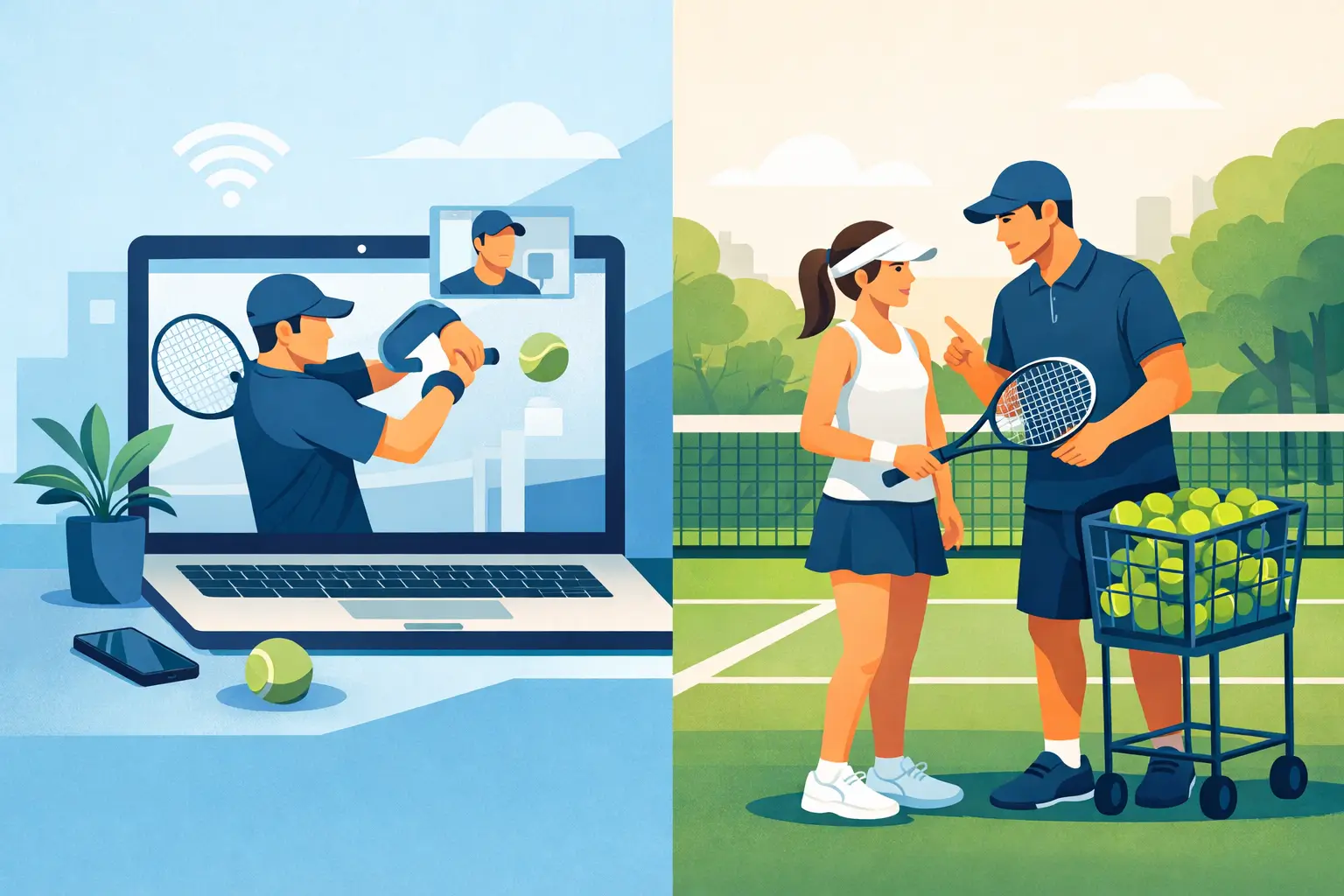
A player spends months hitting hundreds of forehands, yet the same ball keeps sailing long. Another player changes one movement pattern and starts striking cleaner in a single session. That is the real question behind online tennis coaching vs in person. It is not about trend versus tradition. It is about which format actually corrects technical errors faster, more clearly, and with results that hold up under pressure.
Most players assume in-person coaching must be better because the coach is physically on the court. That assumption sounds logical, but it is not always true. If the lesson format does not isolate the cause of the stroke problem and correct it with precision, being courtside does not automatically produce progress. The right coaching method matters more than the room, the court, or the screen.
What players are really comparing
When people compare online tennis coaching vs in person, they usually talk about convenience first. Online saves travel time. In-person gives live court presence. Those points matter, but they are not the main issue for serious players and coaches.
The real comparison comes down to feedback quality, speed of correction, repetition, retention, and transfer to match play. A lesson is only valuable if it changes the stroke. If a player still has the same faulty forehand takeback, the same unstable contact point, or the same late backhand preparation after ten lessons, the format did not solve the problem.
That is why broad claims like “in-person is more personal” or “online is more flexible” are too shallow. The best format is the one that identifies the exact technical fault and fixes it in a way the player can repeat.
Where in-person coaching still has a clear edge
In-person coaching has strengths, and any honest comparison should say that clearly. A coach on court can control feeding, adjust rally tempo, read footwork in real time, and create pressure drills that simulate match conditions. For younger athletes especially, that physical presence can improve focus and accountability.
There is also an emotional factor. Some players respond better when a coach is standing next to them, stopping the point, repositioning them, and demanding immediate change. For advanced competitors working on patterns, movement, or tactical decision-making, in-person work can be extremely effective.
But there is a trade-off. Real-time instruction often moves too fast for technical rebuilding. A player hits, hears a cue, hits again, and keeps layering new advice on top of the same broken motion. The coach sees it. The player feels busy. Progress looks active, but the flaw remains.
That is where traditional in-person lessons often lose efficiency. They can become correction by commentary instead of correction by design.
Why online tennis coaching vs in person is not a simple quality test
Online coaching exposes something many players miss – seeing the stroke clearly is often more powerful than hearing about it repeatedly. Video allows technical patterns to be slowed down, isolated, and compared frame by frame. Contact point, spacing, shoulder alignment, racquet path, split-step timing – none of this has to be guessed.
This is why online coaching can outperform in-person coaching for stroke repair. The player is not relying on memory from a fast-paced lesson. The evidence is right there. The error becomes visible. The correction becomes specific. That changes how quickly the brain accepts a new pattern.
Online also creates a major advantage in repetition. A player can revisit the same correction between sessions instead of trying to remember what the coach said three days ago. For technical work, that matters. Good stroke development is not built on motivation. It is built on precise repetition.
The weak version of online coaching, of course, is generic video analysis with vague advice. If the instruction is broad, delayed, or overloaded with theory, the player gets information but not transformation. So online is not better by default. It is better when the method is exact.
The deciding factor is the teaching system
Players often compare formats when they should be comparing systems. A weak method in person is still a weak method. A precise method online can produce faster results because it removes distractions and focuses directly on the fault.
That is why some online lessons feel distant and ineffective, while others feel as if the coach is right there on court. The difference is not the camera. The difference is whether the teaching system breaks the stroke into the right sequence and corrects the cause rather than the symptom.
For example, if a forehand keeps floating, the issue may not be “finish lower” or “brush up more.” It may start earlier with spacing, unit turn, or how the player loads before contact. If the coach misidentifies the source, the lesson goes nowhere. If the coach identifies it correctly and rebuilds it step by step, progress can happen fast, even online.
That is the standard serious players should use.
Who benefits most from online coaching
Online coaching is especially strong for players with stubborn groundstroke problems, busy training schedules, or limited access to high-level technical instruction locally. It also works exceptionally well for coaches who want to sharpen their eye and improve how they diagnose mechanics.
A player trying to fix a forehand or backhand does not always need another basket of balls. They need the right correction. If the technical error has been repeated for months or years, random live reps will not solve it. Targeted analysis and structured retraining will.
This is also why a specialized system like Mili’s Split Method stands apart. When online instruction is built to replicate the feel of an on-court lesson and is centered on fixing groundstroke errors with scientific precision, the old assumption that online is somehow second-best breaks down fast. Serious players do not care about old assumptions. They care about whether the ball comes off the strings cleanly and consistently.
Who still needs in-person work most often
If the priority is movement training, point construction, live return games, transition play, or competitive rehearsal, in-person work remains highly valuable. Those elements are dynamic and often benefit from a coach controlling space, pace, and pressure in real time.
Beginners can also benefit from in-person coaching if they struggle with basic coordination or need direct physical demonstration to understand positions. Some players simply learn better in a shared physical environment. That is not weakness. It is learning style.
But even here, there is nuance. A player may do technical rebuilding online and then use in-person sessions to test the new stroke under movement and stress. That combination is often more effective than relying on one format alone.
The smartest answer is often both
The strongest approach for many players is not choosing sides. It is using each format for what it does best. Online coaching can accelerate technical correction because it gives the player visual proof, repeatable instruction, and a cleaner learning process. In-person coaching can then pressure-test those changes through feeding, rallying, and match situations.
That is a serious training model. First, fix the stroke. Then build it into the full game.
For coaches, this matters even more. If you teach only in person, online review can sharpen diagnosis and make your live sessions more precise. If you teach mostly online, occasional in-person observation can reveal movement details that support the technical work. The coach who combines both intelligently will outperform the coach who clings to one format out of habit.
How to choose without wasting time
Ask one hard question before committing to any coach or program: how exactly will this fix my stroke problem? Not motivate me. Not encourage me. Fix it.
If the answer is vague, the format will not save it. If the coach can identify the fault, explain the correction clearly, and show a repeatable path to change, you are in the right place. That can happen on court or online. But only one of those may fit your schedule, location, and learning style.
So when evaluating online tennis coaching vs in person, stop treating the screen as the weakness and the court as the advantage. That is outdated thinking. The real advantage is precision. The real edge is a method that creates measurable change fast and holds up over time.
Choose the format that gives you the clearest correction, the fastest repeatable improvement, and the strongest evidence that your forehand and backhand will not keep breaking down when the match gets tight. That is the choice that moves your game forward.