
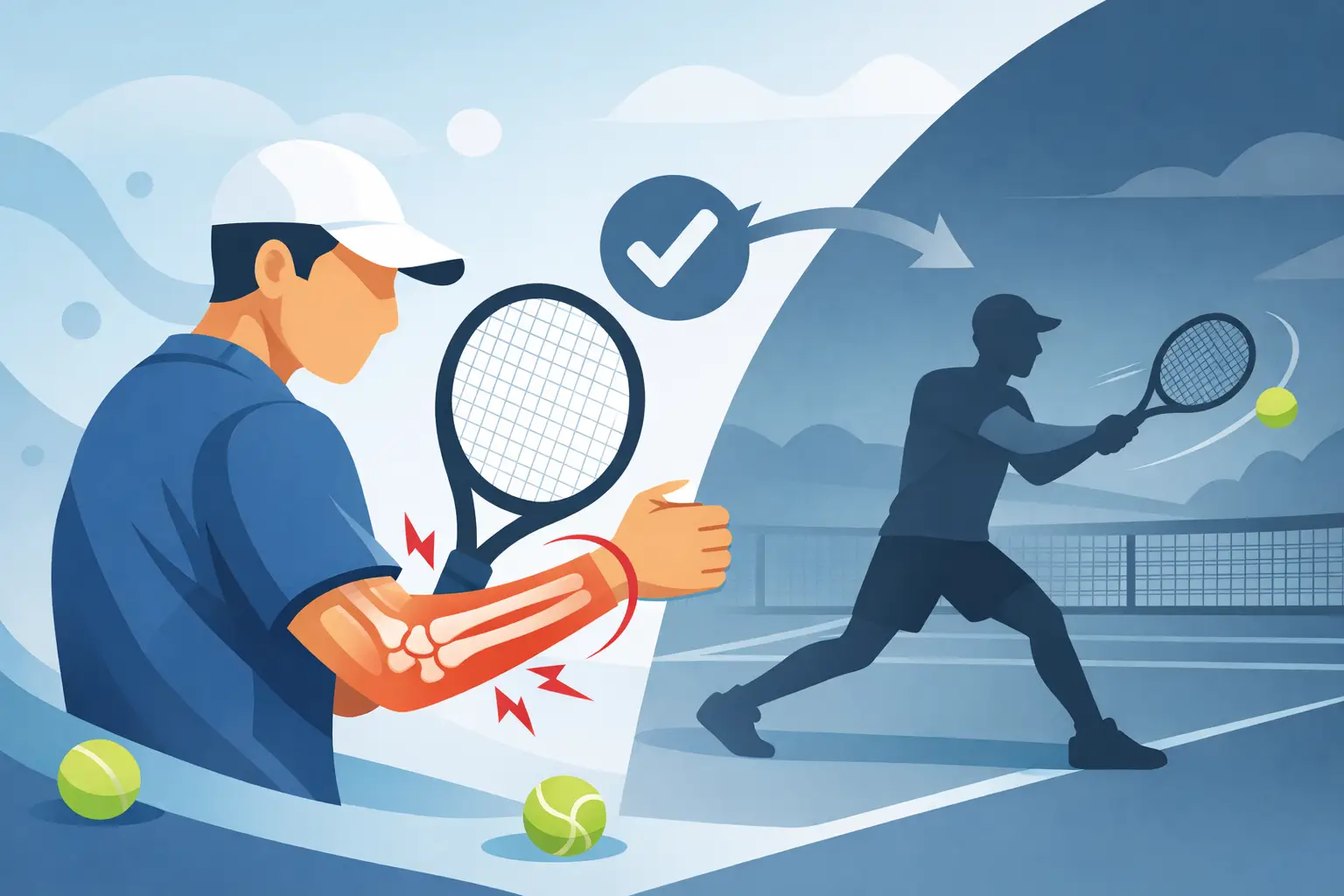
You can spot a wristy forehand before the ball crosses the net. The racquet flips, the contact point floats, and the shot has no repeatable shape. If you want to eliminate tennis wristy forehand problems, you do not need more effort. You need the correct sequence. That is the difference between a forehand that holds up under pressure and one that breaks apart as soon as the rally speeds up.
A wrist-dominant forehand feels fast because the hand is moving a lot. That is exactly why it fails. The wrist is a small link in the chain. When it takes over, the bigger drivers of the stroke – legs, torso, shoulder, and arm structure – stop doing their job. The result is late contact, inconsistent spin, poor control, and often pain on the outside of the elbow or through the wrist itself.
Why a wristy forehand happens
Most players do not choose a wristy forehand on purpose. They build it as a compensation. Sometimes the setup is late, so the hand tries to rescue the shot. Sometimes the grip is unstable, so the player manipulates the racquet face at the last second. Sometimes the player has been told to “snap” for topspin, which creates the wrong intention from the start.
There is also a common visual mistake. Players watch high-level forehands and think the wrist is actively creating speed. It is not. What they are seeing is a chain reaction. The body drives, the arm organizes, and the wrist responds. That is not the same as flicking. Passive release is efficient. Active flipping is a leak.
For advanced players and coaches, this distinction matters. You cannot fix a wristy forehand by telling someone to keep the wrist rigid. That often creates a stiff arm, slower racquet speed, and even worse timing. The solution is not to freeze the wrist. The solution is to put the stroke in the right order.
Eliminate tennis wristy forehand by fixing sequence first
The cleanest forehands are built from the ground up. The unit turn starts the stroke. The spacing puts the player in a position where the contact can happen in front. The body rotation supplies the force. The arm delivers the racquet on a stable path. The wrist stays organized instead of becoming the engine.
If sequence is wrong, every correction becomes temporary. A player may hit ten cleaner balls while thinking about the hand, then lose the pattern the moment pace increases. This is why quick fixes fail so often. They target the symptom, not the source.
At Mili’s Split Method, this is exactly where fast change happens. When the sequence is taught correctly, players stop manufacturing the shot with the hand and start producing it with structure. That is why broken forehands can change far faster than most players think.
The contact point tells the truth
If you want a simple checkpoint, look at contact. A wristy forehand usually contacts too close to the body, too low, or too late. From there, the hand has no option except to improvise. Improvisation is not technique.
A stable forehand meets the ball out in front with space between the hitting arm and the torso. That one detail changes everything. It gives the player time, a clearer racquet path, and a contact that does not need rescuing.
The wrist should be organized, not frozen
The wrist has a role. It helps position the racquet and transmit speed. But it must do that from a stable structure. Think firm, not stiff. Think responsive, not active.
When players hear “don’t use your wrist,” they often overcorrect. Then the forehand becomes wooden. The better instruction is this: stop trying to create the shot with your wrist. Let the stroke create the release. That is a major difference, and it is one of the fastest ways to improve consistency.
The mechanics that actually clean it up
Start with the grip. If the hand is constantly shifting or the racquet is sitting too deep in the palm, the player will struggle to control the face without extra wrist action. A secure, repeatable grip gives the racquet a stable relationship to the forearm.
Next comes the takeback. A huge, hand-led backswing often creates panic on the way forward. The player runs out of time and flips at contact. A more efficient preparation keeps the racquet manageable and the hitting structure intact.
Then comes spacing. This is where many wristy forehands are born. If the player crowds the ball, the arm cannot extend naturally through contact. The hand takes over because there is no room for the full chain to work. Better footwork does more to clean up the wrist than most technical tips.
Finally, look at rotation. A forehand without body rotation asks the arm and hand to create speed alone. That is a losing trade. You may gain a little whip on easy balls, but under pressure the shot collapses. When the hips and torso drive correctly, the arm no longer needs to force the action.
Drills to eliminate tennis wristy forehand habits
The best drills do not just make the stroke feel better for five minutes. They remove the reason the wrist was taking over in the first place.
A controlled drop-feed is one of the fastest tools. Stand in an open stance, set the unit turn early, and drop the ball to a comfortable contact height. Your only goal is to meet the ball out in front with a stable racquet face and a smooth body-driven swing. If the wrist flips, the ball flight will expose it immediately.
Short-court forehands are also valuable when done correctly. Keep the rally inside the service boxes and reduce pace. This removes the player’s urge to manufacture power with the hand. Focus on clean spacing and shape. A quality short-court forehand should feel simple, not busy.
Another effective drill is the hold-through-contact pattern. Hit the ball and freeze the arm structure just after contact for a split second. Not for the whole finish, just long enough to confirm that contact was led by the body and arm path rather than a last-second wrist flick. This is especially useful for coaches because it makes the error visible.
Video feedback helps too, but only if you know what to look for. Slow motion should confirm three things: the racquet is prepared on time, the contact is in front, and the wrist is not actively throwing the racquet head at the ball. Without those three, players tend to misread their own motion.
What players get wrong when they try to self-correct
The biggest mistake is chasing more topspin by adding more hand. Topspin is not created by a wrist slap. It comes from racquet path, contact, and speed delivered through the full chain. The wrist participates, but it should never dominate.
The second mistake is over-tightening. Players feel the forehand is loose, so they grip harder and lock the arm. That may reduce the flip for a few balls, but it also kills fluidity. The better answer is correct organization, not more tension.
The third mistake is ignoring footwork. Many forehand faults look like hand problems but begin with poor positioning. If the feet do not create spacing early, the hand has to improvise late. Good coaching identifies that immediately.
For coaches: what to fix first
If you coach players with wristy forehands, do not start with verbal cues about the wrist alone. Start by checking preparation timing, spacing, and contact location. Those three usually reveal why the hand is overworking.
Then simplify the task. Feed slower, shorten the swing intention, and give the player a contact target they can repeat. Once the sequence becomes reliable, the wrist problem often fades without needing constant reminders. That is efficient coaching. More importantly, it is coaching that lasts.
There are cases where equipment, grip style, or previous injury affect the picture. That is where experience matters. But even in those cases, the principle stays the same: the wrist should support the stroke, not save it.
A strong forehand does not feel like a hand trick. It feels connected. When the sequence is right, the ball leaves the strings with shape, weight, and control, and the player no longer has to guess what will happen next. That is the standard. If your forehand still depends on a last-second flip, the fix is not more effort. It is better structure, taught with precision and repeated the right way until the stroke becomes reliable under real match speed.
The good news is that once the wrist stops doing everyone else’s job, the forehand usually improves faster than expected.