
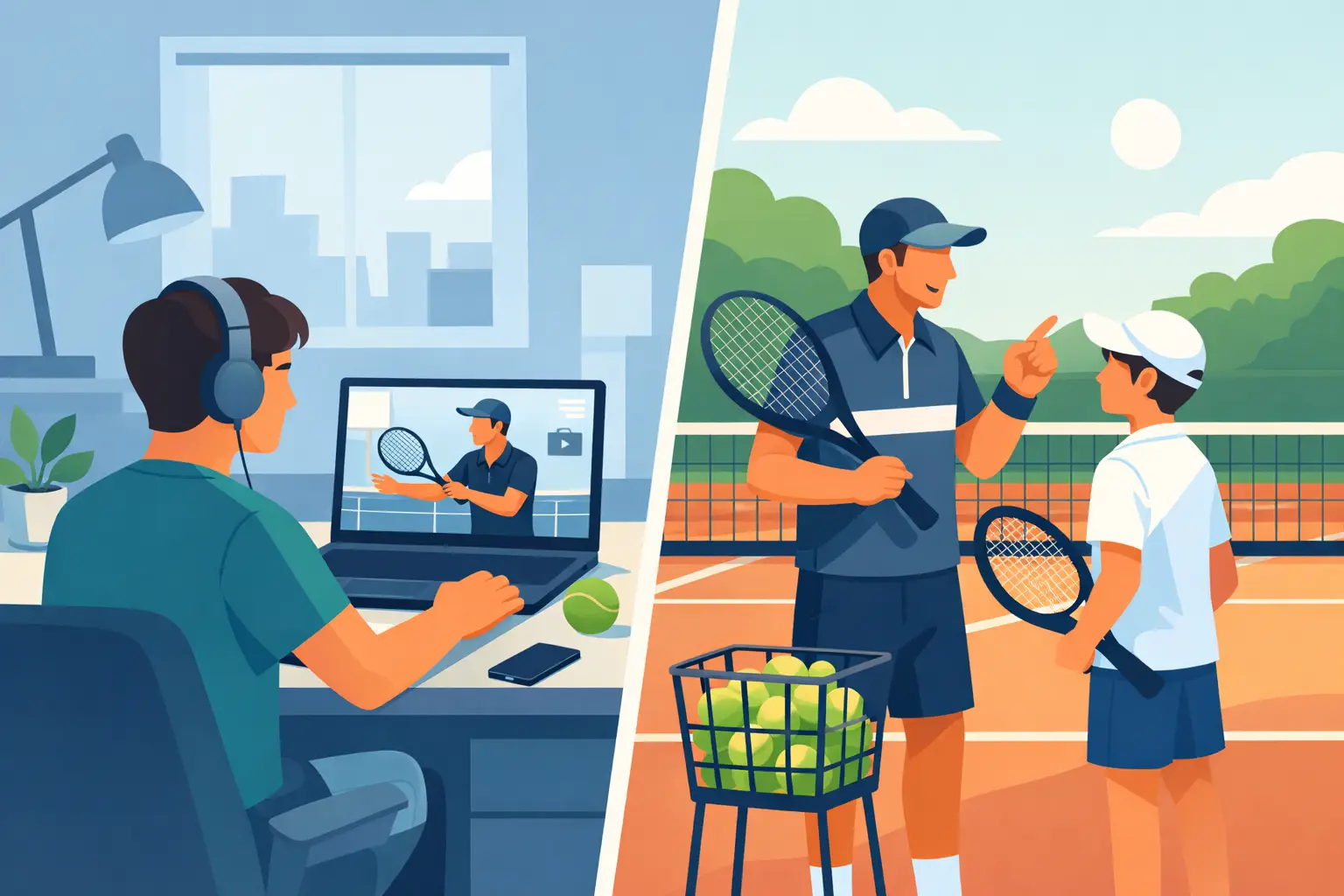
Most players ask the wrong question. They ask whether online coaching is as good as being on court with a coach standing three feet away. The better question is this: can online lessons replace court coaching when the goal is to fix strokes quickly, correctly, and permanently?
For many players, the answer is yes. Not always. Not for every part of tennis. But when the issue is technical correction – especially forehands and backhands – online lessons can do far more than most players and coaches assume. In the right system, they can deliver faster results because they remove noise, force precision, and let the player see exactly what must change.
That matters because traditional court coaching often hides a basic problem. A player can spend months hitting baskets of balls, getting encouragement, hearing general tips, and still repeating the same flawed movement. The session feels productive. The stroke is still broken.
Can online lessons replace court coaching for stroke correction?
If the coach has a precise method, yes. If the coach relies on vague cues and live feeding alone, no.
That distinction is everything. Good stroke correction is not about presence. It is about diagnosis and instruction. A coach does not fix a forehand because he is physically nearby. He fixes it because he knows exactly which movement is wrong, why it is wrong, and how to replace it with the correct pattern.
Online instruction can actually sharpen that process. Video exposes the truth. It slows down contact, spacing, preparation, and follow-through. It removes the illusion that a player is “almost there” when the mechanics are still off. Players see their own stroke clearly, often for the first time, and that creates faster buy-in.
This is where most tennis instruction falls apart. Players are told to swing low to high, watch the ball, or finish over the shoulder. Those are fragments, not solutions. A real fix requires a structured system that identifies the exact fault and applies the exact correction. When that system exists, online teaching becomes powerful.
Where court coaching still has an edge
There are parts of tennis that still benefit from in-person coaching. Footwork under pressure, live ball timing against different opponents, serve returns at full pace, transition play, and tactical decision-making in match conditions are easier to train on court. A coach can feed, react, and adjust in real time.
So no, online lessons do not replace every form of court coaching in every context. Anyone claiming that is oversimplifying the game.
But that does not weaken the case for online training. It clarifies it. If a player has a technical issue in the forehand or backhand, more live rallying is often the slowest way to solve it. Repetition without correction builds the fault deeper. In that situation, online work is not the compromise. It is the smarter first move.
Why online lessons can work better than expected
The main advantage is focus. On court, too much can happen at once. The player is moving, reacting, trying to keep the ball in play, listening to cues, and feeling pressure to perform. Technical learning gets diluted.
Online lessons strip that away. The player studies the movement, compares it to the model, and works on a specific correction. There is no guessing. There is no distraction from ball outcome. That gives the brain a cleaner path to change the motion.
The second advantage is repeatability. A live lesson ends. A strong online lesson stays with the player. They can replay the explanation, review the key checkpoint, and practice with accuracy instead of memory. That is a serious advantage for players who want lasting change, not just a good session.
The third advantage is honesty. Video does not flatter anyone. It shows late preparation, poor spacing, an unstable wrist, a rushed swing path, or a collapse through contact. Once the fault is visible, the correction becomes measurable.
For ambitious players and coaches, that matters. Guesswork wastes time. Precision saves it.
Can online lessons replace court coaching for serious players?
For serious players who want technical breakthroughs, they can replace a large portion of court coaching – and sometimes outperform it.
That may sound bold, but serious players care about results, not tradition. If a player has spent six months on court hearing standard cues and nothing has changed, the format is not the issue. The method is.
A high-level player does not need constant supervision. They need accurate correction. Once they understand the exact adjustment, they can train it with discipline. In fact, many advanced players do better when they are given a precise blueprint and the freedom to repeat it correctly.
The same is true for coaches. Coaches who study stroke mechanics in a structured online system can sharpen their eye faster than they would by relying on instinct alone. They begin to see causes instead of symptoms. That raises the quality of every lesson they teach.
The real weakness is not online coaching – it is bad online coaching
Many people dismiss online tennis lessons because they have seen weak versions of them. Generic tips. Little personalization. No clear sequence. No proof of correction. That criticism is fair.
Bad online coaching is bad coaching with a screen in the middle.
But great online coaching is different. It is built on a method. It isolates the fault. It gives the player a clear model. It explains what to do, what not to do, and how to know the change is happening. Most important, it produces visible transformation.
That is the standard that matters.
At Mili’s Split Method, the reason online lessons feel so close to being on court is simple: the teaching is exact. The method was built to correct groundstroke problems quickly, with a scientifically structured approach and a level of clarity most players have never experienced. When the instruction is that specific, distance stops being the main issue.
When online lessons are the better choice
If your forehand breaks down under pace, if your backhand has never felt natural, or if you keep hearing different advice from different coaches, online lessons may be the better option right now. Not later. Right now.
They are also ideal for players who do not have access to a top-level technical coach in their area. Geography should not limit stroke development. A flawed stroke in California, Florida, Texas, or overseas is still a flawed stroke. What fixes it is the right method.
Online coaching also works well for motivated players who like to study, review, and practice with intention. These players often improve quickly because they are not just hitting balls. They are training a specific change.
When court coaching should stay in the mix
If you are preparing for tournaments and need point construction, return games, defensive movement patterns, and competitive pressure training, court coaching still matters. The court is where tactics become real.
The strongest approach for many players is not choosing one side forever. It is using each format for what it does best. Use online lessons to fix the stroke. Use court coaching to apply it under pressure. That combination is efficient and hard to beat.
This is especially true for coaches who want to offer more value. A coach who understands a proven online correction method and then reinforces it live on court becomes far more effective than a coach who only feeds balls and improvises cues.
The answer depends on what you need fixed
If you want motivation, hitting time, and general guidance, court coaching can do that well.
If you want precise technical correction of groundstrokes, online lessons can absolutely replace court coaching – provided the method is proven, structured, and results-driven.
That is the part many players miss. Tennis improvement is not about choosing the more traditional format. It is about choosing the format that solves the specific problem in front of you.
A player with a broken forehand does not need more tradition. They need a correction that works.
And once players experience a lesson that identifies the fault, shows the fix, and leads to visible change in a short time, the old debate starts to sound outdated. The question stops being whether online coaching can replace court coaching. The real question becomes why so many players stay stuck with methods that never fixed the stroke in the first place.
Choose the format that gives you the truth, the correction, and the result. That is the only standard worth using.