
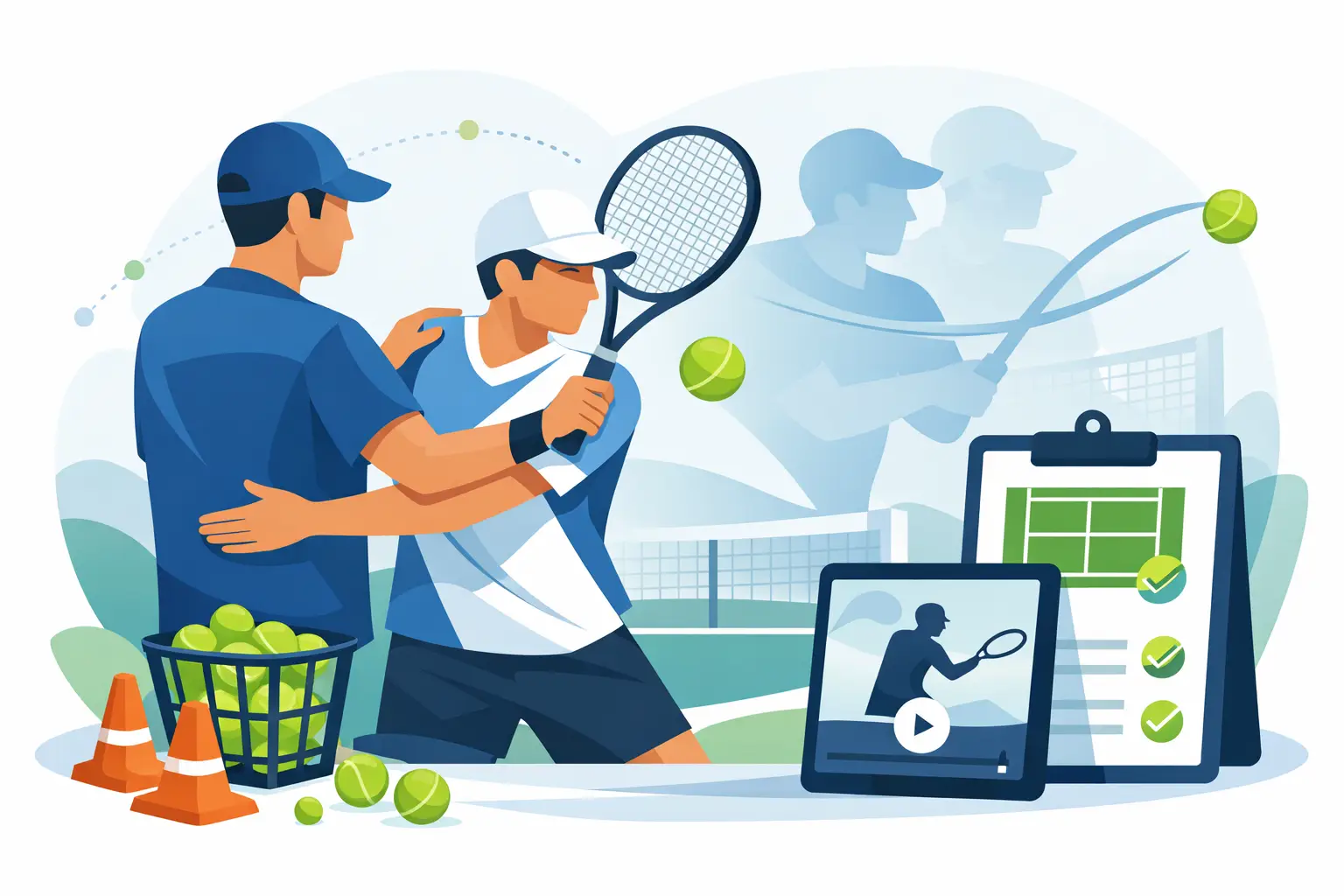
A forehand does not break down by accident. It breaks down because the body repeats a bad sequence until it feels normal. That is why players searching for the best tennis stroke correction programs are usually frustrated with tips, random drills, and lessons that sound smart but do not actually change the stroke.
Stroke correction is not the same as general coaching. General coaching can help you compete better, move better, and think better on court. Stroke correction has a narrower job. It must identify the exact technical fault, replace it with a repeatable pattern, and make that new pattern hold up under pressure. If a program cannot do that quickly and clearly, it is not a correction program. It is just more practice.
What makes the best tennis stroke correction programs work
The best programs are specific. They do not bury players under ten adjustments at once. They isolate the real cause of the error and correct it in the right order.
That order matters more than most players realize. A late contact point might look like a timing issue, but the cause could be poor spacing. A weak backhand might look like a strength issue, but the real problem could be an incorrect preparation phase. If a program treats the symptom and ignores the source, the player improves for a day and then slides right back.
The strongest correction systems also give the player immediate feedback. That can come from live coaching, precise video analysis, or a structured method that lets the player feel the difference between the wrong movement and the correct one. Without that feedback loop, players guess. Guessing is slow, and slow correction is usually incomplete correction.
A serious program should also be able to handle different levels of play. Junior players need clarity and repetition. Competitive adults need correction that survives match pace. Coaches need a method they can apply to multiple body types, learning styles, and stroke habits. The best systems do not rely on vague cues. They rely on teachable mechanics.
Why most tennis stroke correction programs fail
Many programs promise improvement, but improvement is not correction. A player can hit better for a session simply because they are more focused. That does not mean the technical flaw is gone.
The most common failure is overload. The player hears too much at once – turn more, swing lower, relax the wrist, step in, finish higher. None of that helps if the first movement in the stroke is still wrong. Good correction removes noise. It does not add more.
Another failure is generic instruction. Online tennis content is full of broad advice meant to apply to everyone. That is fine for inspiration. It is weak for repair work. Stroke correction requires diagnosis, and diagnosis requires a system.
Then there is the issue of time. Traditional coaching often stretches technical fixes over weeks or months because the method is not built for rapid reconstruction. Players accept that timeline because they think that is just how tennis works. It is not. When the method is exact, the correction can happen far faster.
Best tennis stroke correction programs should be judged by outcomes
If you are comparing options, do not start with branding. Start with results.
A real correction program should answer a few hard questions. Can it identify the fault with precision? Can it explain why the fault happens? Can it produce visible change quickly? Can the player keep the improved stroke when rally speed increases? Can a coach repeat the process with other players?
Those questions cut through marketing fast. Some programs are excellent for fitness, match strategy, or drilling volume. Those are useful, but they are not the same as stroke repair. If your forehand collapses under pressure or your backhand has never been technically sound, you need a method that is built for technical reconstruction, not general improvement.
This is where the difference between information and method becomes obvious. Information tells you what a good stroke looks like. A method tells you how to build it, how to test it, and how to fix it when it slips.
The role of online coaching in stroke correction
Online coaching used to be treated as second best. That is outdated. Poor online coaching is poor, just like poor in-person coaching is poor. But a high-level online correction program can be extremely effective if it is built around precise observation, structured teaching, and clear progression.
In fact, many players learn better online because they can revisit the lesson, compare movements, and focus on exact details without the distraction of a busy court environment. The key is whether the online program feels generic or specific. If it feels like prepackaged advice for the masses, it will not solve a stubborn stroke problem.
The best online correction systems create the sense of direct coaching. They break down the movement, show the fault, give the player a narrow focus, and verify the change. That is what serious players and coaches should demand.
What separates a true correction method from standard lessons
Standard lessons often work around the stroke. A coach feeds balls, the player rallies, and small comments are made along the way. That can help maintenance. It is not always enough for repair.
A true correction method rebuilds the stroke from the point of failure. It is more clinical. It is more direct. It does not assume that more repetition will somehow clean up a flawed movement.
That is why a scientifically structured system has a major advantage. When the teaching sequence is tested and repeatable, the player is not relying on the coach’s mood, instinct, or improvisation. The process has a logic to it. That logic is what makes fast correction possible.
For players and coaches who value certainty, this matters. You do not want a stroke fixed by accident. You want it fixed by design.
A serious option for players and coaches
Among the best tennis stroke correction programs, the ones worth your attention are the ones confident enough to stand behind results. That is rare in tennis because most coaching businesses avoid guarantees. They keep the language safe. They promise support, not outcomes.
Mili’s Split Method takes the opposite position. It is built specifically to correct groundstroke problems fast, using a defined teaching system designed to perfect forehand and backhand mechanics in as little as three days. That claim matters because it reflects a method focused on correction, not endless lesson packages. The money-back guarantee also matters because it places the risk on the program, not on the player.
For players, that means a direct path to solving a stroke issue that has likely lingered too long. For coaches, it means access to a method that can produce consistent results and set them apart in a crowded field. A coach certification program only has value if the underlying system is strong. In this case, the strength is the point.
If you want to see how that approach is presented, the brand’s home base is https://tennismethod.com.
Who benefits most from tennis stroke correction programs
Not every player needs a full correction program. Some players simply need more reps and better footwork. But if you have a recurring technical flaw that shows up every match, every pressure point, or every time pace increases, you are in correction territory.
Junior players benefit because bad patterns become harder to remove as they age. Adult competitors benefit because technical flaws often cap performance no matter how much they play. Coaches benefit because they need more than opinions. They need a reliable process they can teach.
There is also a mental benefit that should not be ignored. When a player knows the stroke has been rebuilt correctly, confidence rises for a reason. It is not fake positivity. It is trust in a movement that finally makes sense.
How to choose the right program for your game
Choose the program that is willing to be specific. Choose the one that can explain the sequence of correction, not just the ideal finish position. Choose the one that values fast, measurable change over endless theory.
Be careful with programs that promise everything at once. A service can be excellent for overall development and still be the wrong fit for technical stroke repair. It depends on your goal. If your goal is to fix a forehand or backhand that is holding back your level, then you need a correction system first and a broader development plan second.
The best decision is usually the simplest one. Go where the method is clear, the results are visible, and the confidence is backed by accountability. In tennis, wasted time is expensive. A corrected stroke changes more than technique – it changes what you believe is possible the next time you step on court.