
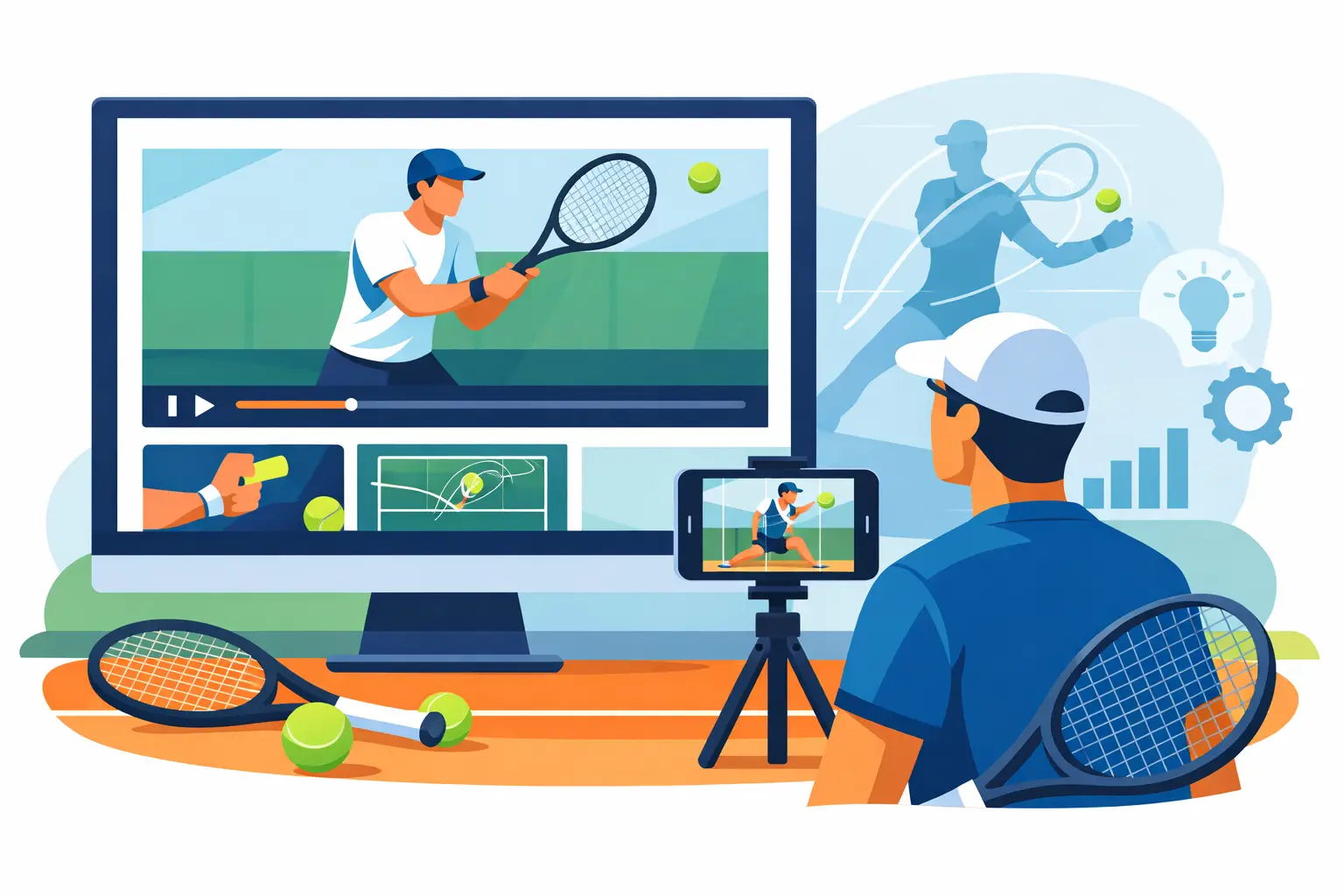
You can hit 500 forehands in a week and still repeat the same mistake 500 times. That is why tennis video coaching matters. It does not just show you what your stroke looks like. When it is done correctly, it identifies the exact fault, explains why it happens, and gives you a precise correction you can apply on the next ball.
Most players have already tried recording themselves. They prop up a phone, hit for ten minutes, watch the clip, and notice something looks off. Then they guess. They adjust the backswing, change the follow-through, or try to copy a pro. That usually creates more confusion, not less. Video by itself is not coaching. Expert interpretation is the difference.
What tennis video coaching should do
Real tennis video coaching is not passive analysis. It is a technical solution. The goal is not to collect footage. The goal is to correct the stroke.
That distinction matters because many players and even many coaches treat video as a replay tool instead of a teaching system. Seeing your forehand in slow motion is useful, but only if the coach can isolate the root cause quickly. A late contact point, poor spacing, a rushed unit turn, and an unstable base can all produce a similar-looking miss. If the diagnosis is wrong, the correction will be wrong too.
Strong video coaching gives you three things at once. First, it shows the mechanical issue clearly. Second, it connects that issue to ball outcome, timing, and body position. Third, it gives you a repeatable fix. If one of those pieces is missing, progress slows down.
Why players get faster results with tennis video coaching
On-court coaching can be excellent, but not every lesson creates clarity. Many players hear general instructions like move your feet, stay low, or finish higher. Those cues are not always wrong. They are often incomplete.
Video changes that. It removes guessing. You can see whether your contact is too far back, whether your shoulders open early, or whether your non-dominant side stops working through the shot. More important, a trained coach can show you which flaw is the priority. That is where speed comes from.
Fast improvement in tennis does not happen when you hear more advice. It happens when the right correction is applied in the right order. This is especially true for forehands and backhands, where one technical flaw often triggers three or four visible symptoms. Fix the source, and the rest starts to organize itself.
For serious players, that is a major advantage. For coaches, it is even bigger. A coach who can diagnose from video with precision can help players faster, communicate with more authority, and eliminate trial-and-error teaching.
What separates useful video coaching from generic feedback
Not all remote coaching is equal. Some programs send back broad comments that sound encouraging but do not change anything. Good effort. Nice swing. Try to rotate more. That is not enough for a player who wants a dependable stroke.
Useful feedback is specific and measurable. It addresses positions, timing, sequence, and cause. It tells the player exactly what is happening before, during, and after contact. It also explains what to rehearse next.
The strongest systems make online lessons feel close to being on court with the coach. That only happens when the teaching method is structured. The coach must know what to look for, how to prioritize corrections, and how to communicate the fix in a way the player can feel immediately.
This is where a specialized method outperforms general instruction. If a coach uses a proven teaching framework rather than opinion-based tips, results become repeatable. That is what ambitious players want. It is also what separates elite coaching businesses from the crowd.
The biggest mistakes players make when using video
The first mistake is filming the wrong angles. If the camera does not show body alignment, spacing, and contact clearly, the analysis will be weaker from the start. The second mistake is sending random clips with no pattern. One clean ball tells you very little. You need enough repetitions to see what the stroke does under normal rhythm.
The third mistake is chasing aesthetics. Players often ask, Does my forehand look like this pro’s forehand? That is the wrong standard. The right question is, Why is my ball not doing what I want under pressure? Effective coaching solves function first. Style follows sound mechanics, not the other way around.
The fourth mistake is trying to fix everything at once. One of the main benefits of video coaching is prioritization. If your base is unstable and your contact is late, the coach must decide which correction gives the fastest return. When players self-coach from video, they usually stack too many changes together and lose timing.
Why this works so well for groundstrokes
Groundstrokes are ideal for video-based correction because the technical chain is visible. Preparation, spacing, load, rotation, contact, and finish can all be tracked frame by frame. That makes forehand and backhand errors easier to diagnose with accuracy than many players realize.
This is also why poor groundstroke habits can be fixed quickly when the method is precise. A player may think the problem is power, consistency, or topspin. In reality, the source may be a single repeated mechanical error. Once that error is identified and corrected, the improvement can happen much faster than traditional weekly lessons suggest.
That is the core promise behind Mili’s Split Method. The method is built to rectify groundstroke issues fast, with a specific teaching structure that targets the exact fault rather than circling around it. For players who are tired of long coaching cycles with vague progress, that difference is decisive.
Who benefits most from tennis video coaching
Competitive juniors benefit because they need efficient correction, not endless explanation. A technical flaw during development can become a match problem very quickly. Video gives them proof, and strong coaching gives them direction.
Adult players benefit because they often have limited court time and want every session to count. They do not want a six-month guessing process. They want to know what is wrong and how to fix it.
Coaches benefit because video sharpens their eye and raises their standard. If they also learn a certification-based method, they gain more than another teaching tip. They gain a system they can apply consistently across different players.
There is one trade-off worth stating clearly. Video coaching is only as good as the coach and the method behind it. A phone camera does not create results. Expert diagnosis does. If the coach lacks a defined system, video can become just another content stream with little transformation attached to it.
What to look for before you trust a coach online
Look for certainty backed by method, not vague enthusiasm. The coach should be able to explain what they fix, how they fix it, and how quickly players typically feel the change. They should also focus on outcomes, not on sounding complicated.
Look for evidence that the online lesson experience is built for action. A player should come away knowing exactly what changed, what to practice, and what to expect next. If the feedback feels generic, the coaching is generic.
And look for accountability. The best coaches stand behind their teaching. That level of confidence usually comes from a method that has already produced repeatable results across many players.
The real value of tennis video coaching
The real value is not convenience, although convenience helps. The real value is precision. You stop wondering why the ball breaks down. You stop collecting random tips. You get a direct answer, then a direct correction.
For players, that means faster technical improvement and more confidence in competition. For coaches, it means stronger credibility and a sharper teaching process. For both, it means less wasted time.
Tennis rewards clarity. When coaching removes confusion and fixes the stroke at its source, progress stops feeling distant and starts feeling obvious. If your forehand or backhand is still not doing what you know it should, the next smart move is simple: get the right eyes on video and let the truth of the stroke show you what to fix next.